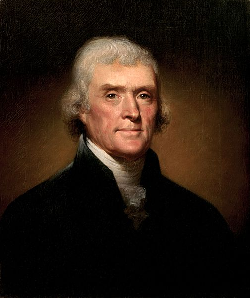
Thomas Jefferson Part 7
American President
- Life
- April 13, 1743 - July 4, 1826
- Birthday
- April 13
- Length
- 22 parts
The French minister said in 1793: "Senator Morris and Secretary of the Treasury Hamilton ... had the greatest influence over the President's mind, and that it was only with difficulty that he [Jefferson] counterbalanced their efforts."Elkins, Stanley and Eric McKitrick (1995). The Age of Federalism New York: Oxford University Press, p. 344. Jefferson supported France against Britain when they fought in 1793."Foreign Affairs," in Peterson, ed. Thomas Jefferson: A Reference Encyclopedia (1986) p 325 Jefferson believed that political success at home depended on the success of the French army in Europe. In 1793, the French minister Edmond-Charles Genêt caused a crisis when he tried to influence public opinion by appealing to the American people, something which Jefferson tried to stop.
During his discussions with George Hammond, first British Minister to the U.S. from 1791, Jefferson tried to achieve three important goals: secure British admission of violating the Treaty of Paris (1783) ; vacate their posts in the Northwest (the territory between the Appalachian Mountains and the Mississippi River north of the Ohio); and compensate the United States to pay American slave owners for the slaves whom the British had freed and evacuated at the end of the war. John C. Miller notes that after failing to gain agreement on any of these, Jefferson resigned in December 1793.Miller, 1977 p.117
Jefferson retired to Monticello, from where he continued to oppose the policies of Hamilton and Washington. The Jay Treaty of 1794, led by Hamilton, brought peace and trade with Britainwhile Madison, with strong support from Jefferson, wanted "to strangle the former mother country" without going to war. "It became an article of faith among Republicans that 'commercial weapons' would suffice to bring Great Britain to any terms the United States chose to dictate."John C. Miller, The Federalist era, 1789–1801 (1960) p 149 Even during the violence of the Reign of Terror in France, Jefferson refused to disavow the revolution because "To back away from France would be to undermine the cause of republicanism in America."Thomas Jefferson, Jean M. Yarbrough, The Essential Jefferson, Hackett Publishing, 2006. (p. xx)
Election of 1796 and Vice Presidency
As the Democratic-Republican (then called Republican) presidential candidate in 1796, Jefferson lost to John Adams, but had enough electoral votes to become Vice President (1797–1801). One of the chief duties of a Vice President is presiding over the Senate, and Jefferson was concerned about its lack of rules leaving decisions to the discretion of the presiding officer. Years before holding his first office, Jefferson had spent much time researching procedures and rules for governing bodies. As a student, he had transcribed notes on British parliamentary law into a manual which he would later call his Parliamentary Pocket Book. Jefferson had also served on the committee appointed to draw up the rules of order for the Continental Congress in 1776. As Vice President, he was ready to reform Senatorial procedures.
With the Quasi-War underway, the Federalists under John Adams started rebuilding the military, levied new taxes, and enacted the Alien and Sedition Acts. Jefferson believed that these acts were intended to suppress Democratic-Republicans rather than dangerous enemy aliens, although the acts were allowed to expire. Jefferson and Madison rallied opposition support by anonymously writing the Kentucky and Virginia Resolutions, which formed the basis of State's rights, declaring that the federal government had no right to exercise powers not specifically delegated to it by the states. Though the resolutions followed the "interposition" approach of Madison, Jefferson advocated nullification. At one point he drafted a threat for Kentucky to secede. Jefferson's biographer Dumas Malone argued that had his actions become known at the time, Jefferson might have been impeached for treason.Chernow, 2004, 1928 p.586
Continue reading: part 8 of 22 →
