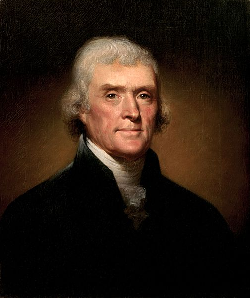
Thomas Jefferson Part 22
American President
- Life
- April 13, 1743 - July 4, 1826
- Birthday
- April 13
- Length
- 22 parts
In 1819, he founded the University of Virginia. Upon its opening in 1825, it was the first university to offer a full slate of elective courses to its students. One of the largest construction projects to that time in North America, the university was notable for being centered about a library rather than a church reinforcing the principle of separation of church and state. No campus chapel was included in Jefferson's original plans. Until his death, Jefferson invited students and faculty of the college to his home.
Jefferson was the principal designer of the University grounds. Its innovative design was an expression of his aspirations for both state-sponsored education and an agrarian democracy in the new Republic. His educational idea of creating specialized units of learning is expressed in the configuration of his campus plan, which he called the "Academical Village". Individual academic units were defined as distinct structures, represented by Pavilions, facing a grassy quadrangle. Each Pavilion housed classroom, faculty office, and residences. Though distinctive, each is visually equal in importance, and they are linked with a series of open-air arcades that are the front facades of student accommodations. Gardens and vegetable plots are placed behind and surrounded by serpentine walls, affirming the importance of the agrarian lifestyle.
Stylistically, Jefferson was a proponent of the Greek and Roman styles, which he believed to be most representative of American democracy by historical association. Each academic unit is designed with a two story temple front facing the quadrangle, while the library is modeled on the Roman Pantheon. A survey of members of the American Institute of Architects identified Jefferson's campus as the most significant work of architecture in America. The University was designed as the capstone of the educational system of Virginia. In his vision, any citizen of the state could attend school with the sole criterion being ability.
Final days
Jefferson's health began to deteriorate in July 1825, from a combination of various illnesses and conditions probably including toxemia, uremia and pneumonia. By May 1826 Jefferson's health was so frail that he was virtually a shut-in and by June he was confined to bed. He spent most of his waking hours going over his finances and debts. On May 22 Jefferson made his last entry in the 'Farm Book', noting the price of lamp oil at a dollar twenty five cents a gallon and the cost of lighting his estate for the last month. On June 24 Jefferson wrote his last letter, to a Washington newspaper, the National Intelligencer',, accessed 4 July 2013. where he once more reaffirmed his faith in the principles set forth in the Declaration of Independence. On July 3 Jefferson was overcome by fever. Realizing he would never leave Monticello again, he was forced to decline an invitation to Washington to attend a fiftieth anniversary celebration of the Declaration.
During the last hours of Jefferson's life he was accompanied by his grandson Thomas Jefferson Randolph and his doctor, Robley Dunglison, and other family members and friends. He was at ease with the idea of death and was ready to die. When his doctor entered his room he said Well Doctor, you see I am still here yet. After being checked by the doctor a family member and a friend offered words of hope that he was looking better to which Jefferson impatiently replied.. Do not imagine for a moment that I feel the smallest solicitude as to the result" at which point he calmly gave directions for his funeral, forbidding any sort of celebration or parade. Moments later Jefferson called the rest of his family and friends around his bedside and with a distinct tone he uttered:
I have done for my country, and for all mankind, all that I could do,and I now resign my soul, without fear, to my God, – my daughter to my country.Rayner, 1834 p9.428–429After falling back to sleep Jefferson later awoke at eight o'clock that evening and spoke his last words, "Is it the fourth yet?". His doctor replied, ''It soon will be".
On July 4 at ten minutes before one o'clock Jefferson died at the age of 83, the fiftieth anniversary of the Declaration of Independence and a few hours before John Adams, whose own last words were, "Independence forever" and "Thomas Jefferson survives."
Jefferson's funeral was held July 5, performed by Reverend Charles Clay. The funeral was a simple and quiet affair, by his own request. No invitations were sent, but some friends and visitors came to the ceremony and burial. Jefferson's remains were carried by "servants, family and friends" to the family grave site at Monticello.Bear, 1974, p.77
Jefferson wrote his own epitaph, which reads:Though born into a wealthy slave-owning family, Jefferson had many financial problems, and died deeply in debt. He gave instructions for disposal of his assets in his will and after his death, his estate, possessions and slaves were sold off in public auctions starting in 1827. In 1831 Monticello was sold by Martha Jefferson and the surviving Jefferson heirs to James Turner Barclay, and in 1834 Barclay in turn sold the house and remaining land to Uriah P. Levy.Kierner, page 246

