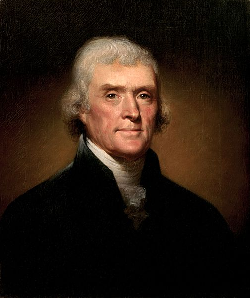
Thomas Jefferson Part 5
American President
- Life
- April 13, 1743 - July 4, 1826
- Birthday
- April 13
- Length
- 22 parts
In early June 1781, Cornwallis dispatched a 250-man cavalry force commanded by Banastre Tarleton on a secret expedition to capture Governor Jefferson and members of the Assembly at Monticello but Jack Jouett of the Virginia militia thwarted the British plan by warning them. Jefferson escaped to Poplar Forest, his plantation to the west. Jefferson believed his gubernatorial term had expired in June, and he spent much of the summer with his family at Poplar Forest.Jouett's Ride His tenure as governor in general, and his decision to flee the capital in particular, was heavily criticized at the time, and has been criticized by historians ever since. The members of the General Assembly had quickly reconvened in June 1781 in Staunton, Virginia across the Blue Ridge Mountains. They voted to reward Jouett with a pair of pistols and a sword, but considered an official inquiry into Jefferson's actions, as they believed he had failed his responsibilities as governor. Jefferson was not re-elected again.
Notes on the State of Virginia
In 1780, Jefferson as governor received numerous questions about Virginia from French diplomat François Barbé-Marbois, who was gathering pertinent data on the United States. Jefferson turned his written responses to Marbois into a book, Notes on the State of Virginia (1785). In a course of five years, Jefferson compiled the book; he included a discussion of contemporary scientific knowledge, and Virginia's history, politics, and ethnography. Jefferson was aided by Thomas Walker, George R. Clark, and geographer Thomas Hutchins. The book was first published in France in 1785 and in England in 1787.Shuffelton. "Introduction" in Notes on the State of Virginia Thomas Jefferson, (1999) The book is Jefferson's argument about what constitutes a good society, which he believed was incarnated by Virginia. It also included extensive data about the state's natural resources and its economy. He wrote extensively about slavery, miscegenation, and his belief that blacks and whites could not live together as free people in one society.
Member of Congress
Following its victory in the Revolutionary War and peace treaty with Great Britain in 1783, the United States formed a Congress of the Confederation (informally called the Continental Congress), to which Jefferson was appointed as a Virginia delegate. As a member of the committee formed to set foreign exchange rates, he recommended that American currency should be based on the decimal system; his plan was adopted. Jefferson also recommended setting up the Committee of the States, to function as the executive arm of Congress. The plan was adopted but failed in practice. Jefferson wrote an ordinance banning slavery in all the nation's territories though it wasn't passed into law.David Brion Davis, The Problem of Slavery in the Age of Revolution: 1770–1823, 1975, p. 174Finkelman, 1989 pp.21-51 He later resigned from Congress when he was appointed as minister to France.
Minister to France
When Jefferson's wife Martha died, friends such as John Adams noted that the widower Jefferson seemed so depressed that he might be suicidal. They believed that sending him to France would take his mind off his wife's death, so he was appointed minister to France in 1785. During his nineteen-day voyage en route to France Jefferson taught himself how to read and write Spanish.Hyland, 2009 p.xviii
Still in his 40s, Jefferson was minister to France from 1785 to 1789, the year the French Revolution started. Months before Jefferson assumed the role as Minister to France he arrived in Paris on August 6, 1784 and four days later rode out to Passy to greet his old friend Benjamin Franklin.Randall, 1994 p.372 When the French foreign minister, the Count de Vergennes, commented to Jefferson, "You replace Monsieur Franklin, I hear," Jefferson replied, "I succeed him. No man can replace him."Hale, 1896 p.119Randall, 1994 p.400 Jefferson attended the ceremony held at Passy bidding farewell to Franklin, who departed for the United States on July 12, 1785.Parton, 1874 p.649
Continue reading: part 6 of 22 →
