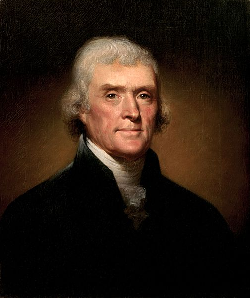
Thomas Jefferson Part 6
American President
- Life
- April 13, 1743 - July 4, 1826
- Birthday
- April 13
- Length
- 22 parts
Though France was at the brink of revolution, Jefferson's tenure there was generally an uneventful one. He often found it difficult to fill the shoes of his predecessor Benjamin Franklin, who at the time was one of the most famous people in the world. He enjoyed the architecture, arts, and the salon culture of Paris. He often dined with many of the city's most prominent people, and stocked up on wines to take back to the US.Lawrence S. Kaplan, Jefferson and France: An Essay on Politics and Political Ideas, Yale University Press, 1980 While in Paris, Jefferson corresponded with many people who had important roles in the imminent French Revolution. These included the Marquis de Lafayette, and the Comte de Mirabeau, a popular pamphleteer who repeated ideals that had been the basis for the American Revolution.Antonina Vallentin, Mirabeau, trans. E. W. Dickes, The Viking Press, 1948, p. 86."." Accessed 1 February 2013. While in Paris he wrote a letter to Edward Carrington expressing some of these ideals he held regarding the natural tendencies of government and its relationship to the people: “the natural process of things is for liberty to yield, and government to gain ground..”Jay Nock, Jefferson (1926). p.100Peterson, 1960 p.413Mayer, 1994, Introduction
Jefferson's eldest daughter Martha, known as Patsy, went with him to France in 1784. His two youngest daughters were in the care of friends in the United States. To serve the household, Jefferson brought some of his slaves, including James Hemings, who trained as a French chef for his master's service. Jefferson's youngest daughter Lucy died of whooping cough in 1785 in the United States, and he was bereft. In 1786, Jefferson met and fell in love with Maria Cosway, an accomplished Italian-English artist and musician of 27. They saw each other frequently over a period of six weeks. A married woman, she returned to Great Britain, but they maintained a lifelong correspondence. In 1787, Jefferson sent for his youngest surviving child, Polly, then age nine. He requested that a slave accompany Polly on the transatlantic voyage. By chance, Sally Hemings, a younger sister of James, was chosen; she lived in the Jefferson household in Paris for about two years.
Secretary of State
In September 1789, Jefferson returned to the US from France with his two daughters and slaves. Immediately upon his return, President Washington wrote to him asking him to accept a seat in his Cabinet as Secretary of State. Jefferson accepted the appointment.
As Washington's Secretary of State (1790–1793), Jefferson argued with Alexander Hamilton, the Secretary of the Treasury, about national fiscal policy,Pearson, Ellen Holmes. "." . Accessed 14 July 2011. especially the funding of the debts of the war. Jefferson later associated Hamilton and the Federalists with "Royalism," and said the "Hamiltonians were panting after ... crowns, coronets and mitres." On May 23, 1792, Jefferson wrote a letter to President Washington describing the political alignments that were visible in the young nation. He urged the president to rally the citizenry in a party that would defend democracy against the corrupting influence of banks and monied interests. Historians recognize this letter as a milestone that defined the founding principles of today’s Democratic Party.William Greider (1992) Who Will Tell The People. Simon & Schuster. New York NY. p. 246. ISBN 0-671-68891-X. Due to their opposition to Hamilton, Jefferson and James Madison organized and led the anti-administration party (called Republican, and known later as Democratic-Republican). He worked with Madison and his campaign manager John J. Beckley to build a nationwide network of Republican allies. Jefferson's political actions and his attempt to undermine Hamilton nearly led Washington to dismiss Jefferson from his cabinet. Although Jefferson left the cabinet voluntarily, Washington never forgave him for his actions, and never spoke to him again.
Yet, according to one account, an earlier private dinner on June 20, 1790 that Jefferson hosted with Hamilton and Madison in New York City "brokered one of the great political deals in American history." Under the terms of this agreement, the nation's capital would be located on the Potomac River, and the federal government would assume the huge war debts of all 13 states.
Continue reading: part 7 of 22 →
