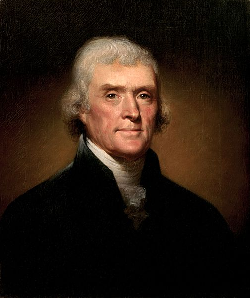
Thomas Jefferson Part 15
American President
- Life
- April 13, 1743 - July 4, 1826
- Birthday
- April 13
- Length
- 22 parts
Other involvements
He obtained the repeal of some federal taxes in his bid to rely more on customs revenue, and dismantled much of the army and navy that he had inherited from Washington and Adams. He pardoned several people imprisoned under the Alien and Sedition Acts, passed in John Adams' term. He repealed the Judiciary Act of 1801, which removed nearly all of Adams' "midnight judges" from office. This quickly led to the Supreme Court deciding the important case of Marbury v. Madison. This also repealed a provision in the act that freed supreme court justices from having to constantly travel the country to serve as circuit court judges. This provision wasn't reinstated for another century, and its repeal under Jefferson ensured that justices would continue to bear heavy travel burdens throughout the nineteenth century. Jefferson also signed into law a bill that officially segregated the US postal system by not allowing blacks to carry mail.John Hope Franklin, Race and History: Selected Essays 1938–1988 (Louisiana State University Press: 1989) p. 336 and John Hope Franklin, Racial Equality in America (Chicago: 1976), p. 24-26
Personal life
Maria Cosway
During his time in Paris as Minister to France, in 1786 the widower Jefferson became attached to Maria Cosway, an English artist, musician and composer. She was a highly educated, married woman with whom he fell in love. They were close and had some relationship about which biographers have speculated; she became part of his intimate circle of friends, and they spent nearly each day together over a six-week period. In 1786 when Cosway returned to London, Jefferson wrote a 4,000-word love letter to her, which has become well known as his "Dialogue of the Head vs. the Heart". After Jefferson left Paris, he and Cosway remained friends and had a lifelong correspondence.Malone Each saved their letters from the other. Similarly, Jefferson kept at Monticello an engraving of Maria done by Luigi Schiavonetti, from a drawing by Richard Cosway. In turn, Cosway had Trumbull create a portrait of Jefferson which she kept.
Jefferson-Hemings controversy
For two centuries, the claim that Thomas Jefferson fathered children by his slave, Sally Hemings, has been a matter of discussion and disagreement. In 1802, the journalist James T. Callender, after being denied a position as postmaster by Jefferson, published allegations that Jefferson had taken Hemings as a concubine and had fathered several children with her.MontBrief The story was repeated by Federalist papers during the election campaigns of 1802 and 1804; most historians argue Jefferson privately denied the rumor in 1805., PBS Frontline, 2000Annette Gordon-Reed, Thomas Jefferson and Sally Hemings: An American Controversy, University of Virginia Press, 1998 (reprint, with new foreword, first published 1997), pp. 40–41, 210–223
John Wayles, the father of Jefferson's wife Martha, was also the father of his former slave Sally Hemings. Consequently, Sally's appearance was strikingly similar to her half-sister, Jefferson's late wife.
According to Sally's son Madison Hemings, Sally and Jefferson began a sexual relationship in Paris and she became pregnant and agreed to return to the United States as his concubine after he promised to free her children when they came of age,
however other scholars note that, Madison made this claim many years later in 1873 at the age of sixty eight, during a politically motivated interview arranged by the Pike County Republican newspaper and that Sally herself produced no known historical documents or statements regarding this or any other issue.Hyland, 2009 pp.88-89Peterson, 1960 pp.185-186, 482During the mid-20th century, historians noted that over a 13-year period during which he was often away for months at a time, Jefferson was at Monticello nine months previous to the birth of each of Hemings' children.Winthrop Jordan, White over Black: American Attitudes Toward the Negro, 1550–1812, Chapel Hill: University of North Carolina Press, 1968Fawn McKay Brodie, Thomas Jefferson, An Intimate History (1974) In 1998, in order to establish the male DNA line, a panel of researchers conducted a Y-DNA study of living descendants of Jefferson's uncle, Field, and of a descendant of Sally's son, Eston Hemings. The results showed a Y-DNA match with the male Jefferson line and were published in the journal Nature. In 2000, the Thomas Jefferson Foundation (TJF) assembled a team of historians whose report concluded that, together with the DNA and historic evidence, there was a high probability that Jefferson was the father of Eston and likely of all Hemings' children. In 2012, the Smithsonian Institution and the TJF mounted an exhibit, Slavery at Jefferson's Monticello: Paradox of Liberty,, NPR: Tell Me More,, 20 February 2012, accessed 25 March 2012. at the National Museum of American History, asserting that most historians accept that the DNA and historical evidence supports the conclusion that Jefferson was the father of Sally Hemings' children,, Slavery at Jefferson's Monticello: Paradox of Liberty, 27 January – 14 October 2012, Smithsonian Institution, Accessed 15 March 2012. while some assert the Monticello report was a "rush to judgement" and that the claims are unsubstantiated and politically driven.Hyland, 2009 pp.76, 119
Continue reading: part 16 of 22 →
