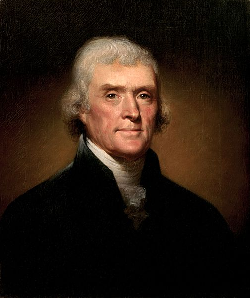
Thomas Jefferson Part 3
American President
- Life
- April 13, 1743 - July 4, 1826
- Birthday
- April 13
- Length
- 22 parts
Jefferson was an accomplished architect who helped popularize the Neo-Palladian style in the United States. Jefferson was interested in birds and wine, and was a noted gourmet. Jefferson was a prolific writer. He learned Gaelic to translate Ossian, and sent to James Macpherson for the originals.
Jefferson invented many small practical devices and improved contemporary inventions. These include the design for a revolving book-stand to hold five volumes at once to be viewed by the reader. Another was the "Great Clock", powered by the Earth's gravitational pull on Revolutionary War cannonballs. Its chime on Monticello's roof could be heard as far as the University of Virginia. Louis Leschot, a machinist, aided Jefferson with the clock. Jefferson invented a long coded wooden cipher wheel, mounted on a metal spindle, to keep secure State Department messages while he was Secretary of State. The messages were scrambled and unscrambled by 26 alphabet letters on each circular segment of the wheel. He improved the moldboard plow and the polygraph, in collaboration with Charles Willson Peale.
As Minister to France, Jefferson was impressed by France's military standardization program known as the Système Gribeauval. As president, he initiated a program at the Federal Armories to develop interchangeable parts for firearms.Hounshell 1984 Although not realized in Jefferson's lifetime, the concept of interchangeable parts eventually led to modern industry and was a major factor in the United States' industrial power by the late 19th century.
Jefferson can also be accredited as the creator of the swivel chair, the first of which he created and used to write much of the Declaration of Independence.
Writings
- A Summary View of the Rights of British America (1774)
- Declaration of the Causes and Necessity of Taking Up Arms (1775)
- Memorandums taken on a journey from Paris into the southern parts of France and Northern Italy, in the year 1787
- Notes on the State of Virginia (1781)
- Plan for Establishing Uniformity in the Coinage, Weights, and Measures of the United States A report submitted to Congress (1790)
- Manual of Parliamentary Practice for the Use of the Senate of the United States (1801)
- Autobiography (1821)
- Jefferson Bible, or The Life and Morals of Jesus of Nazareth
Political career from 1775 to 1800
Declaration of Independence
Jefferson served as a delegate to the Second Continental Congress beginning in June 1775, soon after the outbreak of the American Revolutionary War. He didn't know many people in the congress, but sought out John Adams who, along with his cousin Samuel, had emerged as a leader of the convention. Jefferson and Adams established a friendship that would last the rest of their lives; it led to the drafting of Jefferson to write the declaration of independence. When Congress began considering a resolution of independence in June 1776, Adams ensured that Jefferson was appointed to the five-man committee to write a declaration in support of the resolution.Maier, 1997, pp.97-105 After discussing the general outline for the document, the committee decided that Jefferson would write the first draft.Boyd, Evolution, 22. The committee in general, and Jefferson in particular, thought Adams should write the document. Adams persuaded the committee to choose Jefferson, who was reluctant to take the assignment, and promised to consult with the younger man. Over the next seventeen days, Jefferson had limited time for writing and finished the draft quickly.Maier, 1997, p.104 Consulting with other committee members, Jefferson also drew on his own proposed draft of the Virginia Constitution, George Mason's draft of the Virginia Declaration of Rights, and other sources. The other committee members made some changes. Most notably Jefferson had written, "We hold these truths to be sacred and un-deniable..." Franklin changed it to, "We hold these truths to be self-evident." A final draft was presented to the Congress on June 28, 1776. The title of the document was "A Declaration by the Representatives of the United States of America, in General Congress assembled."Becker, Declaration of Independence, 4.
Continue reading: part 4 of 22 →
