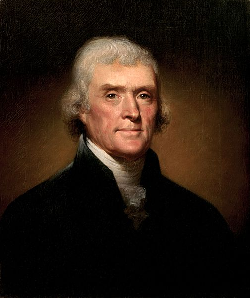
Thomas Jefferson Part 16
American President
- Life
- April 13, 1743 - July 4, 1826
- Birthday
- April 13
- Length
- 22 parts
Since the DNA tests were made public, most biographers and historians have concluded that the widower Jefferson had a long-term relationship with Hemings., History News Network, 25 July 2005, accessed 14 March 2011; Helen F. M. Leary, National Genealogical Society Quarterly, Vol. 89, No. 3, September 2001, pp. 207, 214 – 218 Other scholars, including a team of professors associated with the Thomas Jefferson Heritage Society, maintain that the evidence is insufficient to conclude Thomas Jefferson's paternity, and note the possibility that other Jeffersons, including Thomas's brother Randolph and his five sons, could have fathered Hemings' children., 2001, Thomas Jefferson Heritage SocietyHyland, 2009 pp.30-31
Political philosophy and views
Jefferson idealized the independent yeoman as the best exemplar of republican virtues, distrusted cities and financiers, and often favored decentralized power. He suspended his qualms about exercising the powers of the federal government to buy Louisiana. Jefferson disliked the European system of established churches and called for a wall of separation between church and state at the federal level. (But this was hardly a new idea; Roger Williams (1603–1683), the Puritan-turned-Baptist founder of Rhode Island, had established such a wall at the state level about a century before Jefferson was born, and extended freedom of religion to Quakers and Jews.) Jefferson supported efforts to disestablish the Church of England, called the Anglican Church in Virginia after the Revolution, and authored the Virginia Statute for Religious Freedom.Mayer, 1994 p.76 His Jeffersonian democracy and Democratic-Republican Party became dominant in early American politics. Jefferson's republican political principles were strongly influenced by the 18th-century British opposition writers of the Whig Party. He had high regard for John Locke, Francis Bacon, and Isaac Newton.Pocock, 1975, p.17
Society and government
Jefferson believed that each man has "certain inalienable rights". He defines the right of "liberty" by saying, "Rightful liberty is unobstructed action according to our will within limits drawn around us by the equal rights of others..."Letter to Isaac H. Tiffany, April 4, 1819 in Appleby and Ball (1999) p 224. A proper government, for Jefferson, is one that not only prohibits individuals in society from infringing on the liberty of other individuals, but also restrains itself from diminishing individual liberty. Jefferson and contemporaries like James Madison were well aware of the possibility of tyranny from the majority and held this perspective in their implication of individual rights.Mayer, 1994 p.328 The historian Gordon S. Wood argues that Jefferson's political philosophy was a product of his time and his scientific interests. Influenced by Isaac Newton, he considered social systems as analogous to physical systems. In the social world, Jefferson likens love as a force similar to gravity in the physical world. People are naturally attracted to each other through love, but dependence corrupts this attraction and results in political problems. Wood argues that, though the phrase "all men are created equal" was a cliché in the late 18th century, Jefferson took it further than most. Jefferson held that not only are all men created equal, but they remain equal throughout their lives, equally capable of love as an attractive force. Their level of dependence makes them unequal in practice. Removing or preventing corrupting dependence would enable men to be equal in practice. Jefferson idealized a future in which men would be free of dependencies, particularly those caused by banking or royal influences.
In political terms, Americans thought that virtue was the "glue" that held together a republic, whereas patronage, dependency and coercion held together a monarchy. "Virtue" in this sense was public virtue, in particular self-sacrifice. People commonly thought that any dependence would corrupt this impulse, by making people more subservient to their patrons than to society at large. This derived from the British conception of the nobility, whose economic independence allowed them to work and make personal sacrifices on behalf of the society at large. Americans reasoned that liberty and republicanism required a virtuous society, and the society had to be free of dependence and extensive patronage networks. Jefferson's ideal of the yeoman farmer (or a non-slave-owning planter) personified his ideal of independence. While Jefferson believed most persons could not escape corrupting dependence, the franchise should be extended only to those who could. His fear of dependence and patronage made Jefferson dislike established institutions, such as banking, government, or military. He disliked inter-generational dependence, as well as its manifestations, such as national debt and unalterable governments. For these reasons, he opposed Hamilton's consolidated banking and military plans. Jefferson and Hamilton were diametrically opposed on the issue of individual liberties. While Jefferson believed individual liberty was the fruit of equality and believed government to be the only danger, Hamilton felt that individual liberty must be organized by a central government to assure social, economic and intellectual equality.Peterson, 1960 p.340 Wood argues that Hamilton favored his plans for the very reason that Jefferson feared them, because he believed that they would provide for future American greatness. Jefferson feared a loss of individual liberty for propertied individuals and did not desire imperial stature for the nation.
Continue reading: part 17 of 22 →
