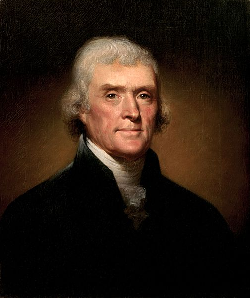
Thomas Jefferson Part 2
American President
- Life
- April 13, 1743 - July 4, 1826
- Birthday
- April 13
- Length
- 22 parts
Education
Jefferson began his childhood education under the direction of tutors at Tuckahoe along with the Randolph children. In 1752, Jefferson began attending a local school run by a Scottish Presbyterian minister. At the age of nine, Jefferson began studying Latin, Greek, and French; he learned to ride horses, and began to appreciate the study of nature. He studied under Reverend James Maury from 1758 to 1760 near Gordonsville, Virginia. While boarding with Maury's family, he studied history, science and the classics.
At age 16, Jefferson entered the College of William & Mary in Williamsburg, and first met the law professor George Wythe, who became his influential mentor. He studied mathematics, metaphysics, and philosophy under Professor William Small, who introduced the enthusiastic Jefferson to the writings of the British Empiricists, including John Locke, Francis Bacon, and Isaac Newton.Peterson, Merrill D. ed. Thomas Jefferson: Writings. New York: Library of America, p. 1236. He also improved his French, Greek, and violin. A diligent student, Jefferson displayed an avid curiosity in all fields by John Hailman, 2006 and graduated in 1762, completing his studies in only two years. Jefferson read law while working as a law clerk for Wythe. During this time, he also read a wide variety of English classics and political works. Jefferson was admitted to the Virginia bar in 1767.
Throughout his life, Jefferson depended on books for his education. He collected and accumulated thousands of books for his library at Monticello. When Jefferson's father Peter died Thomas inherited, among other things, his large library. A significant portion of Jefferson's library was also bequeathed to him in the will of George Wythe, who had an extensive collection. After the British burned the Library of Congress in 1814 Jefferson offered to sell his collection of more than six thousand books to Congress for about four dollars a book. After realizing he was no longer in possession of such a grand collection he wrote in a letter to John Adams, "I cannot live without books". Always eager for more knowledge, Jefferson immediately began buying more books and continued learning throughout most of his life.
Marriage and family
After practicing as a circuit lawyer for several years, Jefferson married the 23-year-old widow Martha Wayles Skelton on January 1, 1772. Martha Jefferson was attractive, gracious and popular with her friends; she was a frequent hostess for Jefferson and managed the large household. They had a happy marriage. She read widely, did fine needle work and was an amateur musician. Jefferson played the violin and Martha was an accomplished piano player. It is said that she was attracted to Thomas largely because of their mutual love of music.Halliday, 2001 pp.48-52 Peterson, 1970 p.27 During the ten years of their marriage, Martha bore six children: Martha, called Patsy, (1772–1836); Jane (1774–1775); an unnamed son (1777); Mary Wayles, called Polly, (1778–1804); Lucy Elizabeth (1780–1781); and Lucy Elizabeth (1782–1785). Only Martha and Mary survived to adulthood.
After her father John Wayles died in 1773, Martha and her husband Jefferson inherited his 135 slaves, and the debts of his estate. These took Jefferson and other co-executors of the estate years to pay off, which contributed to his financial problems. Later in life, Martha Jefferson suffered from diabetes and ill health, and frequent childbirth further weakened her. A few months after the birth of her last child, Martha died on September 6, 1782, at the age of 33. Jefferson was at his wife's bedside and was distraught after her death. In the following three weeks, Jefferson shut himself in his room, where he paced back and forth until he was nearly exhausted. Later he would often take long rides on secluded roads to mourn for his wife. As he had promised his wife, Jefferson never remarried.
Monticello
Jefferson was a farmer, with a lifelong interest in mechanical innovations, new crops, soil conditions, his gardens, and scientific agricultural techniques. His main cash crop was tobacco, but its price was usually low and it was rarely profitable. He tried to achieve self-sufficiency with wheat, vegetables, flax, corn, hogs, sheep, poultry and cattle to feed and clothe his family, slaves and white employees, but he had cash flow problems and was always in debt.Robert Shalhope, "Agriculture," in Merrill D. Peterson, ed., (1986). Thomas Jefferson: A Reference Biography, pp 384–98
Continue reading: part 3 of 22 →
