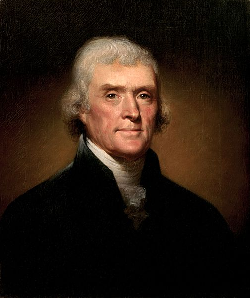
Thomas Jefferson
American President
- Life
- April 13, 1743 - July 4, 1826
- Birthday
- April 13
- Length
- 22 parts
Thomas Jefferson (April 13, 1743 (April 2, 1743 O.S.) – July 4, 1826) was an American Founding Father, the principal author of the Declaration of Independence (1776) and the third President of the United States (1801–1809). At the beginning of the American Revolution, he served in the Continental Congress, representing Virginia and then served as a wartime Governor of Virginia (1779–1781). Just after the war ended, from mid-1784 Jefferson served as a diplomat, stationed in Paris. In May 1785, he became the United States Minister to France.
Jefferson was the first United States Secretary of State (1790–1793) serving under President George Washington. With his close friend James Madison he organized the Democratic-Republican Party, and subsequently resigned from Washington's cabinet. Elected Vice President in 1796, when he came in second to John Adams of the Federalists, Jefferson opposed Adams and with Madison secretly wrote the Kentucky and Virginia Resolutions, which attempted to nullify the Alien and Sedition Acts.
Elected president in what Jefferson called the Revolution of 1800, he oversaw the purchase of the vast Louisiana Territory from France (1803), and sent the Lewis and Clark Expedition (1804–1806) to explore the new west. His second term was beset with troubles at home, such as the failed treason trial of his former Vice President Aaron Burr. With escalating trouble with Britain who was challenging American neutrality and threatening shipping at sea, he tried economic warfare with his embargo laws which only damaged American trade. In 1803, President Jefferson initiated a process of Indian tribal removal and relocation to the Louisiana Territory west of the Mississippi River, in order to open lands for eventual American settlers.Miller (2006), Native America, Discovered And Conquered: Thomas Jefferson, Lewis & Clark, and Manifest Destiny, p. 169
A leader in the Enlightenment, Jefferson was a polymath who spoke five languages fluently and was deeply interested in science, invention, architecture, religion and philosophy, interests that led him to the founding of the University of Virginia after his presidency. He designed his own large mansion on a 5,000 acre plantation near Charlottesville, Virginia, which he named Monticello. While not a notable orator, Jefferson was a skilled writer and corresponded with many influential people in America and Europe throughout his adult life.Rayner, 1834 p.24 He is rated by historians as one of the greatest U.S. presidents.Chernow, 2004 p.589
Though Jefferson owned many slaves, he opposed the institution all his life and consequently treated and took care of his slaves very well, expecting them to work no more than free farmers. Since 1802 historians and others have been divided over the controversy of whether Jefferson was the father of one or more children belonging to Sally Hemings, a slave at Monticello. Historians are also in disagreement with how much Jefferson was committed to the anti-slavery cause. In 1807, President Jefferson signed into law a bill that banned the importation of slaves into the United States. After Martha Jefferson, his wife of eleven years, died in 1782, Jefferson remained a widower for the rest of his life; their marriage produced six children, of whom two survived to adulthood.
Early life and career
The third of ten children, Thomas Jefferson was born on April 13, 1743 (April 2, 1743 OS) at the family home in Shadwell, Goochland County, Virginia, now part of Albemarle County. His father was Peter Jefferson, a planter and surveyor. He was of possible Welsh descent, although this remains unclear. His mother was Jane Randolph, daughter of Isham Randolph, a ship's captain and sometime planter. Peter and Jane married in 1739. Thomas Jefferson showed little interest in learning about his ancestry; he only knew of the existence of his paternal grandfather.
Before the widower William Randolph, an old friend of Peter Jefferson, died in 1745, he appointed Peter as guardian to manage his Tuckahoe Plantation and care for his four children. That year the Jeffersons relocated to Tuckahoe, where they lived for the next seven years before returning to Shadwell in 1752. Peter Jefferson died in 1757 and the Jefferson estate was divided between Peter's two sons; Thomas and Randolph. Thomas inherited approximately of land, including Monticello and between 20 and 40 slaves. He took control of the property after he came of age at 21. The precise amount of land and number of slaves that Jefferson inherited is estimated. The first known record Jefferson made in regards to slave ownership, was in 1774, when he owned 41.
Continue reading: part 2 of 22 →
