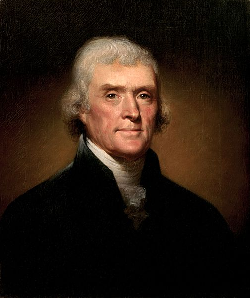
Thomas Jefferson Part 14
American President
- Life
- April 13, 1743 - July 4, 1826
- Birthday
- April 13
- Length
- 22 parts
1804 election and second term
In his second term, Jefferson's popularity suffered because the problems he faced, most notably those caused by the wars in Europe, became more difficult to solve. Relations with Great Britain had always been bad, due partly to the violent personal antipathy between Jefferson and the British Ambassador, Anthony Merry. During Jefferson's first term, Napoleon's position was relatively weak and as such negotiations were possible. After Napoleon's decisive victory at the Battle of Austerlitz in 1805, however, Napoleon became much more aggressive, and most American attempts to negotiate with him were unsuccessful. Jefferson responded with the Embargo Act of 1807, directed also at Great Britain. This triggered economic chaos in the US and was strongly criticized at the time, as it continues to be.Jefferson encouraged passage of the Embargo Act in 1807 to maintain American neutrality in the Napoleonic Wars, which was in accordance with France's Continental System against Britain. Jefferson hoped to avoid national humiliation on the one hand, and war on the other. In the event, he got both war and national humiliation; the economy of the entire Northeast suffered severely, Jefferson was vehemently denounced, and his party lost support. Instead of retreating, Jefferson sent federal agents to secretly track down smugglers and violators.Tucker, 1992 ch.23James Duncan Phillips, "Jefferson's 'Wicked Tyrannical Embargo," New England Quarterly Vol. 18, No. 4 (Dec., 1945), pp. 466–478
The embargo was a financial disaster because the Americans could not export, while widespread disregard of the law meant enforcement was difficult. For the most part, it effectively throttled American overseas trade. All areas of the United States suffered. In commercial New England and the Middle Atlantic states, ships rotted at the wharves, and in the agricultural areas, particularly in the South, farmers and planters could not export their crops. Jefferson's Secretary of the Treasury Albert Gallatin was against the embargo, foreseeing correctly the impossibility of enforcing the policy and the negative public reaction. "As to the hope that it may...induce England to treat us better," wrote Gallatin to Jefferson shortly after the bill had become law, "I think is entirely groundless...government prohibitions do always more mischief than had been calculated; and it is not without much hesitation that a statesman should hazard to regulate the concerns of individuals as if he could do it better than themselves.""Gallatin to Jefferson, December 1807" Vol.1, p.368
Though he had so frequently argued for as small a federal government as possible, Jefferson required the national government to assume extraordinary police powers in an attempt to enforce his policy. The presidential election of 1808, which Madison won, showed that the Federalists were regaining strength, and helped to convince Congress that the Embargo would have to be repealed. Shortly before leaving office, in March 1809, Jefferson signed the repeal of the disastrous Embargo. In its place the Non-Intercourse Act was enacted, which proved no more effective than the Embargo. The government found it was impossible to prevent American vessels from trading with the European belligerents once they had left American ports. Jefferson increasingly believed the problem was the traders and merchants who showed their lack of "republican virtue" by not complying Burton Spivak, Jefferson's English Crisis: Commerce, Embargo, and the Republican Revolution (1978) ch 1 and maintained until his death that had the embargo been lawfully observed by all US citizens it would have avoided war which after its repeal, three days before his term ended, soon followed in 1812.Merwin, 1901 p.142Peterson, 1960 pp.289-290
Historians have generally criticized Jefferson for his embargo policy. Doron Ben Atar argued that Jefferson's commercial and foreign policies were misguided, ineffective and harmful to American interests.Doron S. Ben-Atar, The Origins of Jeffersonian Commercial Policy and Diplomacy (1993) as cited in Cogliano, p 250] Kaplan maintained that the War of 1812 was the logical extension of his embargo and that, by entering the Napoleonic Wars on anti-British side, the United States gave up the advantages of neutrality.
Continue reading: part 15 of 22 →
