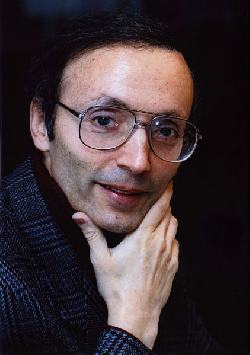
Enoch Powell Part 17
British politician
- Life
- 16 June 1912 - 8 February 1998
- Birthday
- June 16
- Length
- 24 parts
Despite his earlier atheism, Powell became a devout member of the Church of England, thinking in 1949 "that he heard the bells of St Peter's Wolverhampton calling him" while walking to his flat in his (then future) constituency. Subsequently, he became a churchwarden of St. Margaret's, Westminster.
Powell was reading Ancient Greek by the age of five and learned it from his mother. At the age of 70 he began learning his 12th and final language, Hebrew.
In August 2002, Powell appeared 55th in the List of 100 Greatest Britons of all time (voted for by the public in a BBC nationwide poll). When asked by BBC interviewer Michael Parkinson what he regarded as his achievements he replied "...it is doubtful whether any man can say how the world was altered because he was in it."
Powell's rhetorical gifts were also employed, with success, beyond politics. He was a poet of some accomplishment, with four published collections to his name: First Poems; Casting Off; Dancer's End; and The Wedding Gift. His Collected Poems appeared in 1990. He translated Herodotus' Histories and published many other works of classical scholarship. He published a biography of Joseph Chamberlain, which treated the split with William Gladstone over Irish Home Rule in 1886 as the pivotal point of his career, rather than the adoption of tariff reform, and contained the famous line: "All political lives, unless they are cut off in midstream at a happy juncture, end in failure, because that is the nature of politics and of all human affairs". His political publications were often as critical of his own party as they were of Labour, often making fun of what he saw as logical fallacies in reasoning or action. His book Freedom & Reality contained many quotes from Labour party manifestos or by Harold Wilson that he regarded as nonsensical.
Like Tony Benn (a personal friend despite political differences, whose peerage Powell helped to renounce so that Benn remain in the Commons), he was seen by supporters as putting conscience and duty to his constituents before loyalty to his party or the sake of his career.
One young Conservative, during a private meeting at the House of Commons, attempted to express his support for Powell. "Mr. Powell, I am a great supporter of your views." Powell interrupted him. "I do not get letters of support from you. I do not get financial rewards for your support. What is the nature of your support?" he said in his monotone voice. The youth blushed and sat down.
Ulster Unionist
1974–79
In a sudden general election in October 1974, Powell returned to Parliament as Ulster Unionist MP for South Down, having rejected an offer to stand as a candidate for the National Front. He repeated his call to vote Labour due to their policy on the EEC.
Since 1968, Powell had been an increasingly frequent visitor to Northern Ireland, and in keeping with his general British nationalist viewpoint, he sided strongly with the Ulster Unionists in their desire to remain a constituent part of the United Kingdom. From early 1971, he opposed, with increasing vehemence, Heath's approach to Northern Ireland, the greatest breach with his party coming over the imposition of direct rule in 1972. He strongly believed that it would survive only if the Unionists strove to integrate completely with the United Kingdom by abandoning devolved rule in Northern Ireland. He refused to join the Orange Institution, the first Ulster Unionist MP at Westminster never to be a member (and, to date, only one of three, the others being Ken Maginnis and Sylvia Hermon), and he was an outspoken opponent of the more extremist Unionism espoused by the Reverend Ian Paisley and his supporters.
In the aftermath of the Birmingham pub bombings by the Provisional Irish Republican Army (PIRA) on 21 November 1974, the government passed the Prevention of Terrorism Act. During its second reading, Powell warned of passing legislation "in haste and under the immediate pressure of indignation on matters which touch the fundamental liberties of the subject; for both haste and anger are ill counsellors, especially when one is legislating for the rights of the subject". He said terrorism was a form of warfare that could not be prevented by laws and punishments but by the aggressor's certainty that the war was impossible to win.
Continue reading: part 18 of 24 →