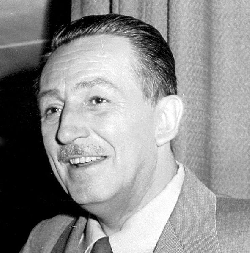
Walt Disney Part 8
Producer, director and animator
- Life
- December 5, 1901 – December 15, 1966
- Birthday
- December 5
- Field
- Art, Art - Other
- Length
- 12 parts
Iwerks was soon lured by Powers into opening his own studio with an exclusive contract, while Stalling would also later leave Disney to join Iwerks. Iwerks launched his Flip the Frog series with the first voiced color cartoon Fiddlesticks, filmed in two-strip Technicolor. Iwerks also created two other cartoon series, Willie Whopper and the Comicolor. In 1936, Iwerks shut down his studio in order to work on various projects dealing with animation technology. He would return to Disney in 1940 and go on to pioneer a number of film processes and specialized animation technologies in the studio’s research and development department.
By 1932, although Mickey Mouse had become a relatively popular cinema character, Silly Symphonies was not as successful. The same year also saw competition increase as Max Fleischer’s flapper cartoon character, Betty Boop, gained popularity among theater audiences. Fleischer, considered Disney’s main rival in the 1930s, was also the father of Richard Fleischer, whom Disney would later hire to direct his 1954 film 20,000 Leagues Under the Sea. Meanwhile, Columbia Pictures dropped the distribution of Disney cartoons to be replaced by United Artists. In late 1932, Herbert Kalmus, who had just completed work on the first three-strip technicolor camera, approached Walt and convinced him to reshoot the black and white Flowers and Trees in three-strip Technicolor. Flowers and Trees would go on to be a phenomenal success and would also win the first Academy Award for Best Short Subject: Cartoons in 1932. After the release of Flowers and Trees, all subsequent Silly Symphony cartoons were in color while Disney was also able to negotiate a two-year deal with Technicolor, giving him the sole right to use their three-strip process, a period eventually extended to five years. Through Silly Symphonies, Disney also created his most successful cartoon short of all time, The Three Little Pigs (1933). The cartoon ran in theaters for many months, featuring the hit song that became the anthem of the Great Depression, "Who’s Afraid of the Big Bad Wolf".
First Academy Award
In 1932, Disney received a special Academy Award for the creation of "Mickey Mouse", a series which switched to color in 1935 and soon launched spin-offs for supporting characters such as Donald Duck, Goofy, and Pluto. Pluto and Donald became standalone cartoons in 1937, with Goofy following in 1939. Of all Mickey’s partners, Donald Duck, who first teamed up with Mickey in the 1934 cartoon, Orphan’s Benefit, was arguably the most popular, going on to become Disney’s second most successful cartoon character of all time.
Children
The Disneys’ first attempt at pregnancy ended in miscarriage. Lillian became pregnant again and gave birth to a daughter, Diane Marie Disney, on December 18, 1933. Later, the Disneys adopted Sharon Mae Disney (December 31, 1936 – February 16, 1993).
Diane married Ron Miller at the age of 20 and is known as Diane Disney Miller. The Millers established and own a winery called Silverado Vineyards in California. Diane and Ron Miller have seven children: Christopher, Joanna, Tamara, Jennifer, Walter, Ronald and Patrick. Years later, Diane went on to become the cofounder of The Walt Disney Family Museum, with the aid of her children. The museum was created to preserve her father’s image and reach out to millions of Disney fans worldwide. The museum displays a chronological view of Walt Disney’s life through personal artifacts, interactive kiosks and various animations.
Sharon Mae Disney was born December 31, 1936, in Los Angeles, California and was later adopted by the Disneys, due to Lillian’s several birth complications. In 1950, Sharon went on to star as herself in the Walt Disney Studios special One Hour in Wonderland. Sharon married Robert Brown in 1958, with whom she had one child, and they remained married until his death in 1967. Sharon married William Lund in 1969 and had two children with him, but six years later they divorced.Barrier, 2008, p.324 Sharon was a philanthropist and had contributed to charities such as the Marianne Frostig Center of Educational Therapy and the Curtis School foundation. In 1993 at the age of 57, Sharon died from cancer at St. John’s Hospital in Santa Monica, California. After Sharon’s death, her estate donated $11 million to the California School of Performing Arts, where she was a member of the board of trustees for almost two decades. Sharon’s donation was commemorated by renaming the School of Dance the Sharon D. Lund School of Dance.
Continue reading: part 9 of 12 →


