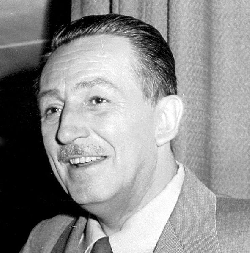
Walt Disney Part 4
Producer, director and animator
- Life
- December 5, 1901 – December 15, 1966
- Birthday
- December 5
- Field
- Art, Art - Other
- Length
- 12 parts
After decades of pursuit, Disney acquired the rights to P. L. Travers’ books about a magical nanny. Mary Poppins, released in 1964, was the most successful Disney film of the 1960s and featured a song score written by Disney favorites, the Sherman Brothers. The same year, Disney debuted a number of exhibits at the 1964 New York World’s Fair, including Audio-Animatronic figures, all of which were later integrated into attractions at Disneyland and a new theme park project which was to be established on the East Coast.
Although the studio would probably have proved major competition for Hanna-Barbera, Disney decided not to enter the race and mimic Hanna-Barbera by producing Saturday morning television cartoon series. With the expansion of Disney’s empire and constant production of feature films, the financial burden involved in such a move would have proven too great.
Plans for Disney World and EPCOT
In late 1965, Disney announced plans to develop another theme park to be called Disney World a few miles southwest of Orlando, Florida. Disney World was to include "the Magic Kingdom", a larger, more elaborate version of Disneyland. It would also feature a number of golf courses and resort hotels. The heart of Disney World, however, was to be the Experimental Prototype City (or Community) of Tomorrow, known as EPCOT for short.
Mineral King Ski Resort
During the early to mid-1960s, Walt Disney developed plans for a ski resort in Mineral King, a glacial valley in California’s Sierra Nevada mountain range. He brought in experts such as the renowned Olympic ski coach and ski-area designer Willy Schaeffler, who helped plan a visitor village, ski runs and ski lifts among the several bowls surrounding the valley. Plans finally moved into action in the mid-1960s, but Walt died before the actual work started. Disney’s death and opposition from conservationists ensured that the resort was never built.
Illness and death
Walt Disney was a chain smoker his entire adult life, although he made sure he was not seen smoking around children.Gabler, Neal 2006 Walt Disney: The Triumph of Imagination, Alfed A. Knofph Inc, New York City In 1966, Disney was scheduled to undergo surgery to repair an old neck injury caused by many years of playing polo at the Riviera Club in Hollywood. On November 2, during pre-operative X-rays, doctors at Providence St. Joseph Medical Center, across the street from the Disney Studio, discovered a tumor in his left lung. Five days later a biopsy showed the tumor to be malignant and to have spread throughout the entire left lung. After removing the lung on November 11, the surgeons informed Disney that his life expectancy was six months to two years. After several cobalt therapy sessions, Disney and his wife spent a short time in Palm Springs, California. On November 30, Disney collapsed at his home. He was revived by fire department personnel and rushed to St. Joseph’s. There, ten days after his 65th birthday, on December 15, 1966, at 9:30 a.m., Disney died of acute circulatory collapse, caused by lung cancer. The last thing he reportedly wrote before his death was the name of actor Kurt Russell, the significance of which remains a mystery, even to Russell.
Roy O. Disney continued with the Florida project, insisting that the name be changed to Walt Disney World in honor of his brother.
The final productions in which Disney played an active role were the animated feature The Jungle Book and the animated short Winnie the Pooh and the Blustery Day, as well as the live-action musical feature The Happiest Millionaire, all released in 1967. Songwriter Robert B. Sherman recalled of the last time he saw Disney:
Hibernation urban legend
A long-standing urban legend maintains that Disney was cryonically frozen, and his frozen corpse stored beneath the Pirates of the Caribbean ride at Disneyland, but Disney’s remains were cremated on December 17, 1966, and his ashes interred at the Forest Lawn Memorial Park in Glendale, California. The first known human cryonic freezing was in January 1967, more than a month after Disney’s death.
Continue reading: part 5 of 12 →


