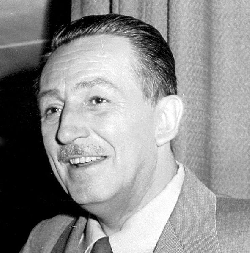
Walt Disney
Producer, director and animator
- Life
- December 5, 1901 – December 15, 1966
- Birthday
- December 5
- Field
- Art, Art - Other
- Length
- 12 parts
Walter Elias "Walt" Disney (December 5, 1901 – December 15, 1966) was an American animator, film producer, director, screenwriter, voice actor, entrepreneur, entertainer, international icon, and philanthropist, well known for his influence in the field of entertainment during the 20th century. Along with his brother Roy O. Disney, he co-founded the Walt Disney Productions, which later became one of the best-known motion picture producers in the world. The corporation is now known as The Walt Disney Company and had an annual revenue of approximately US$36 billion in the 2010 financial year.
Disney was particularly noted as a film producer and a popular showman, as well as an innovator in animation and theme park design. He and his staff created some of the world’s most well-known fictional characters including Mickey Mouse, for whom Disney himself provided the original voice. During his lifetime he received four honorary Academy Awards and won 22 Academy Awards from a total of 59 nominations, including a record four in one year, giving him more awards and nominations than any other individual in history. Disney also won seven Emmy Awards and gave his name to the Disneyland and Walt Disney World Resort theme parks in the U.S., as well as the international resorts like Tokyo Disney Resort, Disneyland Paris, and Hong Kong Disneyland.
He died on December 15, 1966 from lung cancer in Burbank, California. A year later, construction of the Walt Disney World Resort began in Florida. His brother Roy Disney inaugurated the Magic Kingdom on October 1, 1971.
1937–1941: Golden age of animation
"Disney’s Folly": Snow White and the Seven Dwarfs
Following the creation of two cartoon series, in 1934 Disney began planning a full-length feature. The following year, opinion polls showed that another cartoon series, Popeye the Sailor, produced by Max Fleischer, was more popular than Mickey Mouse. Nevertheless, Disney was able to put Mickey back on top as well as increase his popularity by colorizing and partially redesigning the character to become what was considered his most appealing design to date. When the film industry learned of Disney’s plans to produce an animated feature-length version of Snow White, they were certain that the endeavor would destroy the Disney Studio and dubbed the project "Disney’s Folly". Both Lillian and Roy tried to talk Disney out of the project, but he continued plans for the feature, employing Chouinard Art Institute professor Don Graham to start a training operation for the studio staff. Disney then used the Silly Symphonies as a platform for experiments in realistic human animation, distinctive character animation, special effects, and the use of specialized processes and apparatus such as the multiplane camera – a new technique first used by Disney in the 1937 Silly Symphonies short The Old Mill.
All of this development and training was used to increase quality at the studio and to ensure that the feature film would match Disney’s quality expectations. Entitled Snow White and the Seven Dwarfs, the feature went into full production in 1934 and continued until mid-1937, when the studio ran out of money. To obtain the funding to complete Snow White, Disney had to show a rough cut of the motion picture to loan officers. The film premiered at the Carthay Circle Theater on December 21, 1937 and at its conclusion the audience gave Snow White and the Seven Dwarfs a standing ovation. Snow White, the first animated feature in America made in Technicolor, was released in February 1938 under a new distribution deal with RKO Radio Pictures. RKO had been the distributor for Disney cartoons in 1936, after it closed down the Van Beuren Studios in exchange for distribution. The film became the most successful motion picture of 1938 and earned over $8 million on its initial release, the equivalent of $ today.


