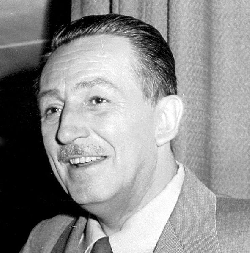
Walt Disney Part 11
Producer, director and animator
- Life
- December 5, 1901 – December 15, 1966
- Birthday
- December 5
- Field
- Art, Art - Other
- Length
- 12 parts
CalArts
In his later years, Disney devoted substantial time to funding The California Institute of the Arts (CalArts). Formed in 1961 through a merger of the Los Angeles Conservatory of Music and the Chouinard Art Institute, which had helped in the training of the animation staff during the 1930s, when Disney died, one-fourth of his estate went to CalArts, which helped in building its campus. In his will, Disney paved the way for the creation of several charitable trusts which included one for the California Institute of the Arts and other for the Disney Foundation. He also donated of the Golden Oaks ranch in Valencia for construction of the school. CalArts moved onto the Valencia campus in 1972.
In an early admissions bulletin, Disney explained: "A hundred years ago, Wagner conceived of a perfect and all-embracing art, combining music, drama, painting, and the dance, but in his wildest imagination he had no hint what infinite possibilities were to become commonplace through the invention of recording, radio, cinema and television. There already have been geniuses combining the arts in the mass-communications media, and they have already given us powerful new art forms. The future holds bright promise for those who imaginations are trained to play on the vast orchestra of the art-in-combination. Such supermen will appear most certainly in those environments which provide contact with all the arts, but even those who devote themselves to a single phase of art will benefit from broadened horizons."
Walt Disney Family Museum
In 2009, The Walt Disney Family Museum opened in the Presidio of San Francisco. Thousands of artifacts from Disney’s life and career are on display, including 248 awards that he received.
Controversy
Accusations of antisemitism and racism
Disney was long rumored to be antisemitic during his lifetime, and such rumors persisted after his death. Indeed, in the 1930s he welcomed German filmmaker and Nazi propagandist Leni Riefenstahl to Hollywood to promote her film Olympia. Even after news of Kristallnacht broke in November 1938, Disney did not cancel his invitation to Riefenstahl.James, Clive (March 25, 2007). . The New York Times. pp. XX.Olympia in America, 1938: Leni Riefenstahl, Hollywood, and the Kristallnacht" by Cooper C. Graham (LOC), Historical Journal of Film, Radio and Television, Vol. 13, No. 4,1993
However, in 2006 Disney biographer Neal Gabler, the first writer to gain unrestricted access to the Disney archives, concluded that available evidence did not support accusations of antisemitism. In a CBS interview Gabler summarized his findings:
Disney eventually distanced himself from the Motion Picture Alliance in the 1950s. Gabler also claims in regards to Riefenstahl’s visit, the invitation was suggested to Disney by Jay Stowitts and that although Walt knew who Riefenstahl was, he didn’t know exactly what she represented in terms of politics, as he had no particular political leaning during the 1930s.
The Walt Disney Family Museum acknowledges that Disney did have "difficult relationships" with some Jewish individuals, and that ethnic stereotypes common to films of the 1930s were included in some early cartoons, such as Three Little Pigs and The Opry House; however, the museum points out that he befriended many Jewish school mates, donated to several Jewish charities (The Hebrew Orphan Asylum, Yeshiva College, Jewish Home for the Aged, The American League for a Free Palestine) and was named "1955 Man of the Year" by the B’nai B’rith chapter in Beverly Hills.
Disney was also rumored to be a racist. According to Gabler, although he was not, he would however occasionally make racially insensitive remarks that were commonly used by white Americans at the time.Gabler, Neal (2006) Walt Disney, The Triumph of American Imagination, Page 433, Alfred A. Knopf Inc. New York City, U.S.A For example during a story meeting on Snow White and the Seven Dwarfs he referred to the scene when the dwarfs pile ontop of each other as a "nigger pile", and while casting Song of the South he used the term pickaninny. Like many Hollywood film and cartoon producers of the time, Disney had engaged in racial stereotyping, and Disney cartoons of the period sometimes displayed racially insensitive material. Examples include Mickey’s Mellerdrammer in which Mickey Mouse dresses in blackface, the "black" bird in the short Who Killed Cock Robbin, Sunflower the half donkey-half black centarette in Fantasia, the feature film Song of the South, the Indians in Peter Pan, and the crows in Dumbo (although in that particular instance they were made sympathetic to Dumbo’s plight). Looney Tunes and Merrie Melodies director Bob Clampett, director of the controversial but highly acclaimed short Coal Black and de Sebben Dwarfs, claimed that Despite Disney’s occasional slurs, there is no evidence that he expressed any hatred or bigotry against any racial group, publicly or privately, and he hired employees of all racial backgrounds, religions, and nationalities throughout his career.Gabler, Neal (2006) Walt Disney, The Triumph of American Imagination, Alfred A. Knopf Inc. New York City, U.S.A He also thoroughly enjoyed To Kill a Mockingbird, a film dealing with racial justice, claiming "That’s the kind of film I wish I could make."
Continue reading: part 12 of 12 →


