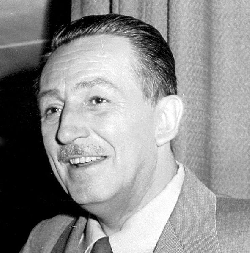
Walt Disney Part 5
Producer, director and animator
- Life
- December 5, 1901 – December 15, 1966
- Birthday
- December 5
- Field
- Art, Art - Other
- Length
- 12 parts
According to "at least one Disney publicist", as reported in the French magazine Ici Paris in 1969, the source of the rumor was a group of Disney Studio animators with "a bizarre sense of humor" who were playing a final prank on their late boss. Urban Legends Reference Pages 1995–2001 by Barbara and David P. Mikkelson
His daughter Diane wrote in 1972, "There is absolutely no truth to the rumor that my father, Walt Disney, wished to be frozen. I doubt that my father had ever heard of cryonics."
1901–1937: Beginnings
Childhood
Disney was born on December 5, 1901, at 2156 N. Tripp Avenue in Chicago’s Hermosa community area to Irish-Canadian father Elias Disney and Flora Call Disney, who was of German and English descent. His great-grandfather, Arundel Elias Disney, had emigrated from Gowran, County Kilkenny, Ireland where he was born in 1801. Arundel Disney was a descendant of Robert d’Isigny, a Frenchman who had travelled to England with William the Conqueror in 1066. With the d’Isigny name anglicized as "Disney", the family settled in a village now known as Norton Disney, south of the city of Lincoln, in the county of Lincolnshire.
In 1878, Disney’s father Elias had moved from Huron County, Ontario, Canada to the United States at first seeking gold in California before finally settling down to farm with his parents near Ellis, Kansas, until 1884. Elias worked for the Union Pacific Railroad and married Flora Call on January 1, 1888, in Acron, Florida, just 40 miles north of where Walt Disney World would ultimately be developed. The family moved to Chicago, Illinois, in 1890,Neal Gabler, "Walt Disney:The Triumph of the American Imagination" (2006), p. 7. hometown of Elias’ brother Robert who helped Elias financially for most of Walt’s early life. In 1906, when Walt was four, Elias and his family moved to a farm in Marceline, Missouri,Neal Gabler, "Walt Disney:The Triumph of the American Imagination" (2006), p. 9-10. where his brother Roy had recently purchased farmland. In Marceline, Disney developed his love for drawingNeal Gabler, "Walt Disney:The Triumph of the American Imagination" (2006), p. 15. with one of the family’s neighbors, a retired doctor named "Doc" Sherwood, paying him to draw pictures of Sherwood’s horse, Rupert. His interest in trains also developed in Marceline, a town that owed its existence to the Atchison, Topeka and Santa Fe Railway which ran through it. Walt would put his ear to the tracks in anticipation of the coming train then try and spot his uncle, engineer Michael Martin, conducting the train.
The Disneys remained in Marceline for four years, before moving to Kansas City in 1911Neal Gabler, "Walt Disney:The Triumph of the American Imagination" (2006), p. 18. where Walt and his younger sister Ruth attended the Benton Grammar School. At school he met Walter Pfeiffer who came from a family of theatre aficionados, and introduced Walt to the world of vaudeville and motion pictures. Before long Walt was spending more time at the Pfeiffers’ than at home. As well as attending Saturday courses at the Kansas City Art Institute, Walt often took Ruth to Electric Park, 15 blocks from their home, which Disney would later acknowledge as a major influence of his design of Disneyland.
Teenage years
In 1917, Elias acquired shares in the O-Zell jelly factory in Chicago and moved his family back to the city,Neal Gabler, "Walt Disney:The Triumph of the American Imagination" (2006), p. 30. where in the fall Disney began his freshman year at McKinley High School and took night courses at the Chicago Art Institute. He became the cartoonist for the school newspaper, drawing patriotic topics and focusing on World War I. Despite dropping out of high school at the age of sixteen to join the army, Disney was rejected for being underage.Neal Gabler, "Walt Disney:The Triumph of the American Imagination" (2006), p. 36.
After his rejection by the army, Walt and a friend decided to join the Red Cross.Neal Gabler, "Walt Disney:The Triumph of the American Imagination" (2006), p. 37. Soon after joining he was sent to France for a year, where he drove an ambulance, but only after the armistice was signed on November 11, 1918.Neal Gabler, "Walt Disney:The Triumph of the American Imagination" (2006), p. 38. Hoping to find work outside the Chicago O-Zell factory,Neal Gabler, "Walt Disney:The Triumph of the American Imagination" (2006), p. 42. in 1919 Walt moved back to Kansas City to begin his artistic career.Neal Gabler, "Walt Disney:The Triumph of the American Imagination" (2006), p. 44. After considering whether to become an actor or a newspaper artist, he decided on a career as a newspaper artist, drawing political caricatures or comic strips. But when nobody wanted to hire him as either an artist or even as an ambulance driver, his brother Roy, then working in a local bank, got Walt a temporary job through a bank colleague at the Pesmen-Rubin Art Studio where he created advertisements for newspapers, magazines, and movie theaters.Neal Gabler, "Walt Disney:The Triumph of the American Imagination" (2006), p. 45. At Pesmen-Rubin he met cartoonist Ubbe IwerksNeal Gabler, "Walt Disney:The Triumph of the American Imagination" (2006), p. 46. and when their time at the studio expired, they decided to start their own commercial company together.Neal Gabler, "Walt Disney:The Triumph of the American Imagination" (2006), p. 48.
Continue reading: part 6 of 12 →


