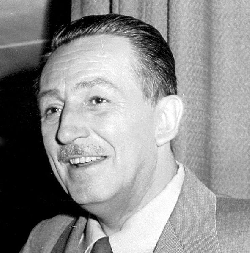
Walt Disney Part 10
Producer, director and animator
- Life
- December 5, 1901 – December 15, 1966
- Birthday
- December 5
- Field
- Art, Art - Other
- Length
- 12 parts
Legacy: 1967–present
Continuing Disney Productions
After Walt Disney’s death, Roy Disney returned from retirement to take full control of Walt Disney Productions and WED Enterprises. In October 1971, the families of Walt and Roy met in front of Cinderella Castle at the Magic Kingdom to officially open the Walt Disney World Resort.
After giving his dedication for Walt Disney World, Roy asked Lillian Disney to join him. As the orchestra played "When You Wish upon a Star", she stepped up to the podium accompanied by Mickey Mouse. He then said, "Lilly, you knew all of Walt’s ideas and hopes as well as anybody; what would Walt think of it [Walt Disney World]?". "I think Walt would have approved," she replied. Roy died from a cerebral hemorrhage on December 20, 1971, the day he was due to open the Disneyland Christmas parade. During the second phase of the "Walt Disney World" theme park, EPCOT was translated by Disney’s successors into EPCOT Center, which opened in 1982. As it currently exists, EPCOT is essentially a living world’s fair, different from the functional city that Disney had envisioned. In 1992, Walt Disney Imagineering took the step closer to Disney’s original ideas and dedicated Celebration, Florida, a town built by the Walt Disney Company adjacent to Walt Disney World, that hearkens back to the spirit of EPCOT. EPCOT was also originally intended to be devoid of Disney characters which initially limited the appeal of the park to young children. The company later changed this policy and Disney characters can now be found throughout the park, often dressed in costumes reflecting the different pavilions.
Disney entertainment empire
Walt Disney’s animation/motion picture studios and theme parks have developed into a multi-billion dollar television, motion picture, vacation destination and media corporation that carry his name. Among other assets The Walt Disney Company owns five vacation resorts, eleven theme parks, two water parks, thirty-nine hotels, eight motion picture studios, six record labels, eleven cable television networks, and one terrestrial television network. As of 2007, the company had annual revenues of over U.S. $35 billion.
Disney Animation
Walt Disney was a pioneer in character animation. He was one of the first people to move away from basic cartoons with just "impossible outlandish gags" and crudely drawn characters to an art form with heartwarming stories and characters the audience can connect to on an emotional level. The personality displayed in the characters of his films and the technological advancements remain influential today. He was considered by many of his colleagues to be a master storyteller and the animation department did not fully recover from his death until the late 1980s in a period known as the Disney Renaissance. The most financially and critically successful films produced during this time include Who Framed Roger Rabbit (1988), The Little Mermaid (1989), Beauty and the Beast (1991), Aladdin (1992) and The Lion King (1994). In 1995, Walt Disney Pictures distributed Pixar’s Toy Story, the first computer animated feature film. Walt Disney’s nephew Roy E. Disney claimed that Walt would have loved Toy Story and that it was "his kind of movie".Roy E. Disney-The Legacy of Toy Story-Toy Story-2005, DVD With the rise of computer animated films a stream of financially unsuccessful Traditional hand-drawn animated features in the early years of the 2000s (decade) emerged. This led to the company’s controversial decision to close the traditional animation department. The two satellite studios in Paris and Orlando were closed, and the main studio in Burbank was converted to a computer animation production facility, firing hundreds of people in the process. In 2004, Disney released what was announced as their final "traditionally animated" feature film, Home on the Range. However, since the 2006 acquisition of Pixar, and the resulting rise of John Lasseter to Chief Creative Officer, that position has changed with the largely successful 2009 film The Princess and the Frog. This marked Disney’s return to traditional hand-drawn animation and the studio hired back staff who had been laid-off in the past. Today, Disney produces both traditional and computer animation.
Continue reading: part 11 of 12 →


