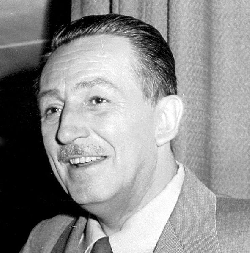
Walt Disney Part 7
Producer, director and animator
- Life
- December 5, 1901 – December 15, 1966
- Birthday
- December 5
- Field
- Art, Art - Other
- Length
- 12 parts
Oswald the Lucky Rabbit
By 1927, Charles Mintz had married Margaret Winkler and assumed control of her business. He then ordered a new, all-animated series to be put into production for distribution through Universal Pictures. The new series, Oswald the Lucky Rabbit, was an almost instant success, and the character, Oswald – drawn and created by Iwerks – became a popular figure. The Disney studio expanded and Walt re-hired Harman, Rudolph Ising, Carman Maxwell, and Friz Freleng from Kansas City.
Disney went to New York in February 1928 to negotiate a higher fee per short and was shocked when Mintz told him that not only did he want to reduce the fee he paid Disney per short but also that he had most of his main animators, including Harman, Ising, Maxwell, and Freleng—but not Iwerks, who refused to leave Disney—under contract and would start his own studio if Disney did not accept the reduced production budgets. Universal, not Disney, owned the Oswald trademark, and could make the films without Walt. Disney declined Mintz’s offer and as a result lost most of his animation staff whereupon he found himself on his own again.Neal Gabler, "Walt Disney:The Triumph of the American Imagination" (2006), p. 109.
It subsequently took his company 78 years to get back the rights to the Oswald character when in 2006 the Walt Disney Company reacquired the rights to Oswald the Lucky Rabbit from NBC Universal, through a trade for longtime ABC sports commentator Al Michaels., at ESPN web site. Retrieved January 4, 2010
Mickey Mouse
After losing the rights to Oswald, Disney felt the need to develop a new character to replace him, which was based on a mouse he had adopted as a pet while working in his Laugh-O-Gram studio in Kansas City. Ub Iwerks reworked the sketches made by Disney to make the character easier to animate although Mickey’s voice and personality were provided by Disney himself until 1947. In the words of one Disney employee, "Ub designed Mickey’s physical appearance, but Walt gave him his soul." Besides Oswald and Mickey, a similar mouse-character is seen in the Alice Comedies, which featured "Ike the Mouse". Moreover, the first Flip the Frog cartoon called Fiddlesticks showed a Mickey Mouse look-alike playing fiddle. The initial films were animated by Iwerks with his name prominently featured on the title cards. Originally named "Mortimer", the mouse was later renamed "Mickey" by Lillian Disney, who thought that the name Mortimer did not sound appealing. Mortimer eventually became the name of Mickey’s rival for Minnie – taller than his renowned adversary and speaking with a Brooklyn accent.
The first animated short to feature Mickey, Plane Crazy was a silent film like all of Disney’s previous works. After failing to find a distributor for the short and its follow-up, The Gallopin’ Gaucho, Disney created a Mickey cartoon with sound called Steamboat Willie. A businessman named Pat Powers provided Disney with both distribution and Cinephone, a sound-synchronization process. Steamboat Willie became an instant success,Neal Gabler, "Walt Disney:The Triumph of the American Imagination" (2006), p. 128. and Plane Crazy, The Galloping Gaucho, and all future Mickey cartoons were released with soundtracks. After the release of Steamboat Willie, Disney successfully used sound in all of his subsequent cartoons, and Cinephone also became the new distributor for Disney’s early sound cartoons.Neal Gabler, "Walt Disney:The Triumph of the American Imagination" (2006), p. 129. Mickey soon eclipsed Felix the Cat as the world’s most popular cartoon character and by 1930, despite their having sound, cartoons featuring Felix had faded from the screen after failing to gain attention. Mickey’s popularity would subsequently skyrocket in the early 1930s.
Silly Symphonies
Following in the footsteps of Mickey Mouse series, a series of musical shorts titled, Silly Symphonies were released in 1929. The first, The Skeleton Dance was entirely drawn and animated by Iwerks, who was also responsible for drawing the majority of cartoons released by Disney in 1928 and 1929. Although both series were successful, the Disney studio thought it was not receiving its rightful share of profits from Pat Powers,Neal Gabler, "Walt Disney:The Triumph of the American Imagination" (2006), p. 142. and in 1930, Disney signed a new distribution deal with Columbia Pictures. The original basis of the cartoons was their musical novelty with the first Silly Symphony cartoons featuring scores by Carl Stalling.
Continue reading: part 8 of 12 →


