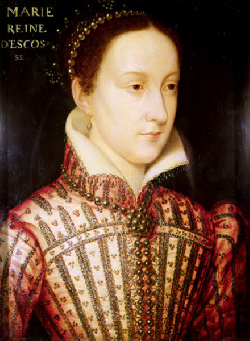
Mary, Queen of Scots Part 9
Scottish monarch
- Life
- 8 December 1542 - 8 February 1587
- Birthday
- December 8
- Length
- 10 parts
English statesmen William Cecil and the Earl of Leicester had worked to obtain Darnley's licence to travel to Scotland from his home in England.; ; Although her advisors had thus brought the couple together, Elizabeth felt threatened by the marriage, because as descendants of her aunt, both Mary and Darnley were claimants to the English throne; whose children would inherit an even stronger, combined claim. However, Mary's insistence on the marriage seems to have stemmed from passion rather than calculation. The English ambassador Nicholas Throckmorton stated "the saying is that surely she [Queen Mary] is bewitched", adding that the marriage could only be averted "by violence". The union infuriated Elizabeth, who felt the marriage should not have gone ahead without her permission, as Darnley was both her cousin and an English subject.
Mary's marriage to a leading Catholic precipitated Mary's half-brother, the Earl of Moray, to join with other Protestant lords, including Lords Argyll and Glencairn, in open rebellion.; Mary set out from Edinburgh on 26 August 1565 to confront them, and on the 30th Moray entered Edinburgh, but left soon afterward having failed to take the castle. Mary returned to Edinburgh the following month to raise more troops. In what became known as the Chaseabout Raid, Mary and her forces and Moray and the rebellious lords roamed around Scotland without ever engaging in direct combat. Mary's numbers were boosted by the release and restoration to favour of Lord Huntly's son, and the return of James Hepburn, 4th Earl of Bothwell, from exile in France.; ; Unable to muster sufficient support, in October Moray left Scotland for asylum in England.; ; ; Mary broadened her privy council, bringing in both Catholics (Bishop of Ross John Lesley and provost of Edinburgh Simon Preston of Craigmillar) and Protestants (the new Lord Huntly, Bishop of Galloway Alexander Gordon, John Maxwell of Terregles and Sir James Balfour).
Before long, Darnley grew arrogant. Not content with his position as king consort, he demanded the Crown Matrimonial, which would have made him a co-sovereign of Scotland with the right to keep the Scottish throne for himself if he outlived his wife.; Mary refused his request, and their marriage grew strained even though they conceived by October 1565. He was jealous of her friendship with her Catholic private secretary, David Rizzio, who was rumoured to be the father of her child.; By March 1566, Darnley had entered into a secret conspiracy with Protestant lords, including the nobles who had rebelled against Mary in the Chaseabout Raid.; ; ; On 9 March, a group of the conspirators, accompanied by Darnley, murdered Rizzio in front of the pregnant Mary at a dinner party in Holyrood Palace.; ; Over the next two days, a disillusioned Darnley switched sides, and Mary received Moray at Holyrood.; ; On the night of 11–12 March, Darnley and Mary escaped from the palace, and took temporary refuge in Dunbar Castle before returning to Edinburgh on 18 March.; ; ; The former rebels Lords Moray, Argyll and Glencairn were restored to the council.; ;
Murder of Darnley
Mary's son by Darnley, James, was born on 19 June 1566 in Edinburgh Castle, but the murder of Rizzio had made the breakdown of Mary's marriage inevitable.; In October 1566, she was staying at Jedburgh in the Scottish Borders when she made a journey on horseback of at least four hours each way to visit the Earl of Bothwell at Hermitage Castle, where he lay ill from wounds sustained in a skirmish with border reivers.; ; ; The ride was later used as evidence by Mary's enemies that the two were lovers, though no suspicions were voiced at the time and Mary was accompanied by her councillors and guards.; Immediately after her return to Jedburgh, she suffered a serious illness that included frequent vomiting, loss of sight, loss of speech, convulsions and periods of unconsciousness. She was thought to be near death or dying. Her recovery from 25 October onwards was credited to the skill of her French physicians.; ; The cause of her illness is unknown; diagnoses include physical exhaustion and mental stress,; haemorrhage of a gastric ulcer,; and porphyria.
Continue reading: part 10 of 10 →
