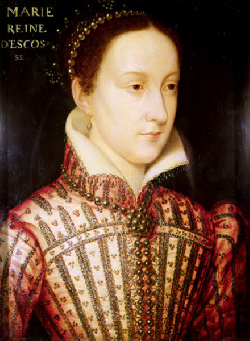
Mary, Queen of Scots Part 3
Scottish monarch
- Life
- 8 December 1542 - 8 February 1587
- Birthday
- December 8
- Length
- 10 parts
Vivacious, beautiful, and clever (according to contemporary accounts), Mary had a promising childhood. While in the French court, she was a favourite with everyone, except Henry II's wife Catherine de' Medici.; ; Catherine's dislike of Mary became apparent only after Henry II's death ( ). Catherine's interests competed with those of the Guise family, and there may have been an element of jealousy or rivalry between the two queens ( ). Mary learned to play lute and virginals, was competent in prose, poetry, horsemanship, falconry and needlework, and was taught French, Italian, Latin, Spanish, and Greek, in addition to speaking her native Scots.; ; Her future sister-in-law, Elisabeth of Valois, became a close friend of whom Mary "retained nostalgic memories in later life". Her maternal grandmother, Antoinette de Bourbon, was another strong influence on her childhood,; and acted as one of her principal advisors.
Portraits of Mary show that she had a small, oval-shaped head, a long, graceful neck, bright auburn hair, hazel-brown eyes, under heavy lowered eyelids and finely arched brows, smooth pale skin, a high forehead, and regular, firm features. She was considered a pretty child and later, as a woman, strikingly attractive.; At some point in her infancy or childhood, she caught smallpox, but it did not mark her features.;
Mary was eloquent and especially tall by sixteenth-century standards (she attained an adult height of 5 feet 11 inches or 1.80 m), while Henry II's son and heir, Francis, stuttered and was abnormally short. Henry commented that "from the very first day they met, my son and she got on as well together as if they had known each other for a long time". On 4 April 1558, Mary signed a secret agreement bequeathing Scotland and her claim to England to the French crown if she died without issue.; ; Twenty days later, she married the Dauphin at Notre Dame de Paris, and Francis became king consort of Scotland.
Claim to the English throne
After the death of Henry VIII's elder daughter, Queen Mary I of England, in November 1558, she was succeeded by her only surviving sibling, Elizabeth I. Under the Third Succession Act, passed in 1543 by the Parliament of England, Elizabeth was recognised as her sister's heir, and Henry VIII's last will and testament had excluded the Stuarts from succeeding to the English throne. Yet, in the eyes of many Catholics, Elizabeth was illegitimate, and Mary Stuart, as the senior descendant of Henry VIII's elder sister, was the rightful queen of England.; Henry II of France proclaimed his eldest son and his daughter-in-law king and queen of England, and in France the royal arms of England were quartered with those of Francis and Mary.; ; ; Mary's claim to the English throne was a perennial sticking point between her and Elizabeth I.;
When Henry II died on 10 July 1559 from injuries sustained in a joust, fifteen-year-old Francis became King of France, with Mary, aged sixteen, as his queen consort.; ; ; Two of Mary's uncles, the Duke of Guise and the Cardinal of Lorraine, were now dominant in French politics,; enjoying an ascendancy called by some historians la tyrannie Guisienne.
File:Francois Second Mary Stuart.jpg|Mary (age 16) and Francis II (age 15) shortly after Francis was crowned King of France in 1559 File:Royal Arms of the Kingdom of Scotland (1558-1559).svg|Royal arms of Mary as Queen of Scots and Dauphine of France File:Royal Arms of the Kingdom of Scotland (1559-1560).svg|Royal arms of Mary as Queen of Scots and Queen consort of France File:Royal Arms of Mary, Queen of Scots, France & England.PNG|Mary's arms as Queen of Scots and France with the arms of England added, used in France before the Treaty of Edinburgh, 1560 File:Royal Arms of the Kingdom of Scotland (1560-1565).svg|Royal arms of Mary as Queen of Scots and Queen dowager of France
In Scotland, the power of the Protestant Lords of the Congregation was rising at the expense of Mary's mother, who maintained effective control only through the use of French troops.; ; ; The Protestant Lords invited English troops into Scotland in an attempt to secure Protestantism, and a Huguenot rising in France, called the Tumult of Amboise, in March 1560 made it impossible for the French to send further support.; Instead, the Guise brothers sent ambassadors to negotiate a settlement. On 11 June 1560, their sister Mary of Guise died, and so the question of the succession and future Franco-Scots relations was a pressing one. Under the terms of the Treaty of Edinburgh, signed by Mary's representatives on 6 July 1560, France and England undertook to withdraw troops from Scotland and France recognised Elizabeth's right to rule England. However, the seventeen-year-old Mary, still in France and grieving for her mother, refused to ratify the treaty.; ; ;
Continue reading: part 4 of 10 →
