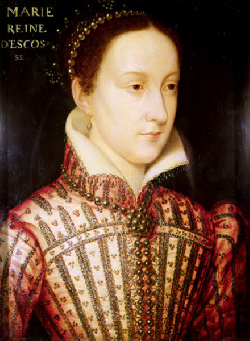
Mary, Queen of Scots Part 4
Scottish monarch
- Life
- 8 December 1542 - 8 February 1587
- Birthday
- December 8
- Length
- 10 parts
Return to Scotland
King Francis II died on 5 December 1560, of a middle ear infection which led to an abscess in his brain. Mary was grief-stricken.; Her mother-in-law, Catherine de' Medici, became regent for the late king's ten-year-old brother Charles IX, who inherited the French throne.;
Mary returned to Scotland nine months after her husband's death, arriving in Leith on 19 August 1561.; ; Mary had lived in France since the age of five, and had little direct experience of the dangerous and complex political situation in Scotland. As a devout Catholic, she was regarded with suspicion by many of her subjects, as well as by Elizabeth, her father's cousin. Scotland was torn between Catholic and Protestant factions, and Mary's illegitimate half-brother, the Earl of Moray, was a leader of the Protestants. The Protestant reformer John Knox preached against Mary, condemning her for hearing Mass, dancing, and dressing too elaborately.Knox, John, History of the Reformation of Religion in Scotland, 4th Book, various editions, e.g., Lennox, Cuthbert (editor) (1905). London: Andrew Melrose, pp. 225–337 She summoned him to her presence to remonstrate with him unsuccessfully, and later charged him with treason, but he was acquitted and released.; ;
To the disappointment of the Catholic party, however, Mary tolerated the newly established Protestant ascendancy,; and kept her half-brother Lord Moray as her chief advisor. Her privy council of 16 men, appointed on 6 September 1561, retained those who already held the offices of state and was dominated by the Protestant leaders from the reformation crisis of 1559–1560: the Earls of Argyll, Glencairn, and Moray. Only four of the councillors were Catholic: the Earls of Atholl, Erroll, Montrose, and Huntly, who was Lord Chancellor.The other members were Lord Justice Clerk John Bellenden of Auchinoul, Lord Clerk Register James MacGill of Nether Rankeillour, Secretary of State William Maitland of Lethington, Lord High Treasurer Robert Richardson, Lord High Admiral the Earl of Bothwell, the Earls of Arran and Morton, the Earl Marischal, and John, Lord Erskine (later Earl of Mar) (). Modern historian Jenny Wormald found this remarkable, suggesting that Mary's failure to appoint a council sympathetic to Catholic and French interests was an indication of her focus on the goal of the English throne over the internal problems of Scotland. Even the one significant later addition to the council, in December 1563, Lord Ruthven, was another Protestant whom Mary personally disliked. In this, she was acknowledging her lack of effective military power in the face of the Protestant lords, while also following a policy which strengthened her links with England. She joined with Lord Moray in the destruction of Scotland's leading Catholic magnate, Lord Huntly, in 1562 after he led a rebellion in the Highlands against her.; ;
Mary sent William Maitland of Lethington as an ambassador to the English court to put the case for Mary as the heir presumptive to the English throne. Elizabeth refused to name a potential heir, fearing that to do so would invite conspiracy to displace her with the nominated successor.; However, Elizabeth assured Maitland that she knew no one with a better claim than Mary. In late 1561 and early 1562, arrangements were made for the two queens to meet in England at York or Nottingham in August or September 1562, but Elizabeth sent Sir Henry Sidney to cancel in July because of the civil war in France.;
Mary turned her attention to finding a new husband from the royalty of Europe. However, when her uncle the Cardinal of Lorraine began negotiations with Archduke Charles of Austria without her consent, she angrily objected and the negotiations foundered.; ; Her own attempt to negotiate a marriage to Don Carlos, the mentally unstable heir apparent of King Philip II of Spain, was rebuffed by Philip.; ; Elizabeth attempted to neutralise Mary by suggesting that she marry English Protestant Robert Dudley, 1st Earl of Leicester (Sir Henry Sidney's brother-in-law and the English queen's own favourite), whom Elizabeth trusted and thought she could control. She sent ambassador Thomas Randolph to tell Mary that if she would marry an English nobleman, Elizabeth would "proceed to the inquisition of her right and title to be our next cousin and heir". The proposal came to nothing, not least because the intended bridegroom was unwilling.; ; ;
Continue reading: part 5 of 10 →
