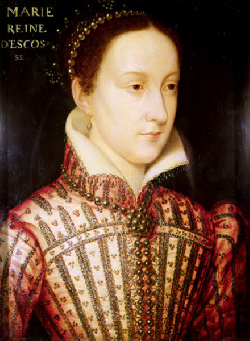
Mary, Queen of Scots Part 10
Scottish monarch
- Life
- 8 December 1542 - 8 February 1587
- Birthday
- December 8
- Length
- 10 parts
At Craigmillar Castle, near Edinburgh, at the end of November 1566, Mary and leading nobles held a meeting to discuss the "problem of Darnley".; Divorce was discussed, but then a bond was probably sworn between the lords present to get rid of Darnley by other means:; ; ; "It was thought expedient and most profitable for the common wealth ... that such a young fool and proud tyrant should not reign or bear rule over them; ... that he should be put off by one way or another; and whosoever should take the deed in hand or do it, they should defend."Confession of James Ormiston, one of Bothwell's men, 13 December 1573, quoted (from Robert Pitcairn's Ancient Criminal Trials in Scotland from AD 1488 to AD 1624) in ; Darnley feared for his safety and after the baptism of his son at Stirling shortly before Christmas, he went to Glasgow to stay on his father's estates. At the start of the journey, he was afflicted by a fever, possibly smallpox, syphilis, or the result of poison, and he remained ill for some weeks.
In late January 1567, Mary prompted her husband to come back to Edinburgh. He recuperated from his illness in a house belonging to the brother of Sir James Balfour at the former abbey of Kirk o' Field, just within the city wall.; ; Mary visited him daily, so that it appeared a reconciliation was in progress. On the night of 9–10 February 1567, Mary visited her husband in the early evening and then attended the wedding celebrations of a member of her household, Bastian Pagez.; ; In the early hours of the morning, an explosion devastated Kirk o' Field, and Darnley was found dead in the garden, apparently smothered.; There were no visible marks of strangulation or violence on the body.; A post-mortem revealed internal injuries, thought to have been caused by the explosion. John Knox claimed the surgeons who examined the body were lying, and that Darnley had been strangled, but all the sources agree there were no marks on the body and there was no reason for the surgeons to lie as Darnley was murdered either way (). Bothwell, Moray, Secretary Maitland, the Earl of Morton and Mary herself were among those who came under suspicion. Elizabeth wrote to Mary of the rumours, "I should ill fulfil the office of a faithful cousin or an affectionate friend if I did not ... tell you what all the world is thinking. Men say that, instead of seizing the murderers, you are looking through your fingers while they escape; that you will not seek revenge on those who have done you so much pleasure, as though the deed would never have taken place had not the doers of it been assured of impunity. For myself, I beg you to believe that I would not harbour such a thought."The original letter is in French, this translation is from . For other versions see and .
By the end of February, Bothwell was generally believed to be guilty of Darnley's assassination.; Lennox, Darnley's father, demanded that Bothwell be tried before the Estates of Parliament, to which Mary agreed, but Lennox's request for a delay to gather evidence was denied. In the absence of Lennox, and with no evidence presented, Bothwell was acquitted after a seven-hour trial on 12 April.; A week later, Bothwell managed to get more than two dozen lords and bishops to sign the Ainslie Tavern Bond, in which they agreed to support his aim to marry the queen.; ;
Imprisonment in Scotland and abdication
Between 21 and 23 April 1567, Mary visited her son at Stirling for the last time. On her way back to Edinburgh on 24 April, Mary was abducted, willingly or not, by Lord Bothwell and his men and taken to Dunbar Castle, where he may have raped her.James Melville of Halhill, who was in the castle, wrote that Bothwell "had ravished her and lain with her against her will" (quoted in ). Other contemporaries dismissed the abduction as bogus ( ). See also ; ; and . On 6 May, Mary and Bothwell returned to Edinburgh and on 15 May, at either Holyrood Palace or Holyrood Abbey, they were married according to Protestant rites. Bothwell and his first wife, Jean Gordon, who was the sister of Lord Huntly, had divorced twelve days previously.; ;
Originally Mary believed that many nobles supported her marriage, but things soon turned sour between the newly elevated Bothwell (created Duke of Orkney and consort of the Queen) and his old peers, and the marriage was deeply unpopular. Catholics considered the marriage unlawful, since they did not recognise Bothwell's divorce or the validity of the Protestant service. Both Protestants and Catholics were shocked that Mary should marry the man accused of murdering her husband. The marriage was tempestuous, and Mary became despondent.; Twenty-six Scottish peers, known as the confederate lords, turned against Mary and Bothwell, raising an army against them. Mary and Bothwell confronted the lords at Carberry Hill on 15 June, but there was no battle as Mary's forces dwindled away through desertion during negotiations.; Bothwell was given safe passage from the field, and the lords took Mary to Edinburgh, where crowds of spectators denounced her as an adulteress and murderer. The following night, she was imprisoned in Loch Leven Castle, on an island in the middle of Loch Leven.; ; Between 20 July and 23 July, Mary miscarried twins. On 24 July, she was forced to abdicate in favour of her one-year-old son James.; ; Moray was made regent,; ; ; while Bothwell was driven into exile. He was imprisoned in Denmark, became insane and died in 1578.;

