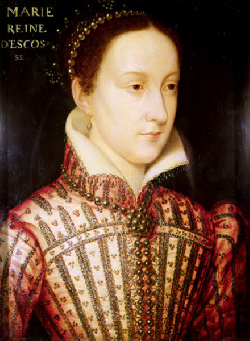
Mary, Queen of Scots Part 7
Scottish monarch
- Life
- 8 December 1542 - 8 February 1587
- Birthday
- December 8
- Length
- 10 parts
Family tree
Notes
Death
Trial
On 11 August 1586, after being implicated in the Babington Plot, Mary was arrested while out riding and taken to Tixall.; In a successful attempt to entrap her, Walsingham had deliberately arranged for Mary's letters to be smuggled out of Chartley. Mary was misled into thinking her letters were secure, while in reality they were deciphered and read by Walsingham.; ; From these letters it was clear that Mary had sanctioned the attempted assassination of Elizabeth.; ; She was moved to Fotheringay Castle in a four-day journey ending on 25 September, and in October was put on trial for treason under the Act for the Queen's Safety before a court of 36 noblemen, including Cecil, Shrewsbury, and Walsingham.Two of the commissioners were Catholics (). Mary denied the charges and was spirited in her defence.; ; ; She told her triers, "Look to your consciences and remember that the theatre of the whole world is wider than the kingdom of England". She drew attention to the facts that she was denied the opportunity to review the evidence, that her papers had been removed from her, that she was denied access to legal counsel and that as a foreign anointed queen she had never been an English subject and thus could not be convicted of treason.;
Mary was convicted on 25 October and sentenced to death with only one commissioner, Lord Zouche, expressing any form of dissent. Despite this, Elizabeth hesitated to order her execution, even in the face of pressure from the English Parliament to carry out the sentence. She was concerned that the killing of a queen set a discreditable precedent, and was fearful of the consequences, especially if, in retaliation, Mary's son James formed an alliance with the Catholic powers and invaded England.; Elizabeth asked Paulet, Mary's final custodian, if he would contrive a clandestine way to "shorten the life" of Mary, which he refused to do on the grounds that he would not make "a shipwreck of my conscience, or leave so great a blot on my poor posterity". On 1 February 1587, Elizabeth signed the death warrant, and entrusted it to William Davison, a privy councillor. On the 3rd, ten members of the Privy Council of England, having been summoned by Cecil without Elizabeth's knowledge, decided to carry out the sentence at once.
Execution
At Fotheringhay on the evening of 7 February 1587, Mary was told that she was to be executed the next morning.; ; She spent the last hours of her life in prayer, distributing her belongings to her household, and writing her will and a letter to the King of France.; The scaffold that was erected in the Great Hall was two feet high and draped in black. It was reached by two or three steps and furnished with the block, a cushion for her to kneel on and three stools, for her and the earls of Shrewsbury and Kent, who were there to witness the execution.; The executioners (one named Bull and his assistant) knelt before her and asked forgiveness. She replied, "I forgive you with all my heart, for now, I hope, you shall make an end of all my troubles."; Her servants, Jane Kennedy and Elizabeth Curle, and the executioners helped Mary to remove her outer garments, revealing a velvet petticoat and a pair of sleeves in crimson-brown, the liturgical colour of martyrdom in the Catholic Church,; ; ; with a black satin bodice and black trimmings.Morris, John (ed.) (1874). , pp. 368–369 As she disrobed she smiled and said that she "never had such grooms before ... nor ever put off her clothes before such a company".; She was blindfolded by Kennedy with a white veil embroidered in gold, knelt down on the cushion in front of the block, on which she positioned her head, and stretched out her arms. Her last words were, "In manus tuas, Domine, commendo spiritum meum" ("Into thy hands, O Lord, I commend my spirit"). Mary was not beheaded with a single strike. The first blow missed her neck and struck the back of her head. The second blow severed the neck, except for a small bit of sinew, which the executioner cut through using the axe. Afterward, he held her head aloft and declared, "God save the Queen." At that moment, the auburn tresses in his hand turned out to be a wig and the head fell to the ground, revealing that Mary had very short, grey hair.; A small dog owned by the queen, a Skye terrier, is said to have been hiding among her skirts, unseen by the spectators. Following the beheading, it refused to be parted from its owner's body and was covered in her blood, until it was forcibly taken away and washed.; Items supposedly worn or carried by Mary at her execution are of doubtful provenance; contemporary accounts state that all her clothing, the block, and everything touched by her blood was burned in the fireplace of the Great Hall to obstruct relic-hunters.
Continue reading: part 8 of 10 →
