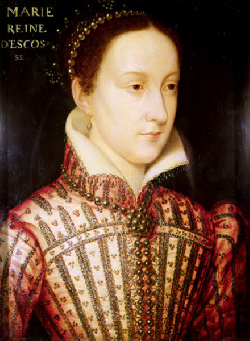
Mary, Queen of Scots Part 5
Scottish monarch
- Life
- 8 December 1542 - 8 February 1587
- Birthday
- December 8
- Length
- 10 parts
In contrast, a French poet at Mary's court, Pierre de Boscosel de Chastelard, was apparently besotted by Mary.; In early 1563, he was discovered during a security search hidden underneath her bed, apparently planning to surprise her when she was alone and declare his love for her. Mary was horrified and banished him from Scotland. He ignored the edict, and two days later he forced his way into her chamber as she was about to disrobe. She reacted with fury and fear, and when Moray rushed into the room, in reaction to her cries for help, she shouted, "Thrust your dagger into the villain!", which Moray refused to do as Chastelard was already under restraint. Chastelard was tried for treason, and beheaded. Maitland claimed that Chastelard's ardour was feigned, and that he was part of a Huguenot plot to discredit Mary by tarnishing her reputation.;
Escape and imprisonment in England
On 2 May 1568, Mary escaped from Loch Leven with the aid of George Douglas, brother of Sir William Douglas, the castle's owner.; ; ; She managed to raise an army of 6000 men, and met Moray's smaller forces at the Battle of Langside on 13 May.; She was defeated and fled south; after spending the night at Dundrennan Abbey, she crossed the Solway Firth into England by fishing boat on 16 May.; : She landed at Workington in Cumberland in the north of England and stayed overnight at Workington Hall. On 18 May, she was taken into protective custody at Carlisle Castle by local officials.;
Mary apparently expected Elizabeth to help her regain her throne.; ; ; Elizabeth was cautious, and ordered an inquiry into the conduct of the confederate lords and the question of whether Mary was guilty of the murder of Darnley.; Mary was moved by the English authorities to Bolton Castle in mid-July 1568, because it was further from the Scottish border but not too close to London. A commission of inquiry, or conference as it was known, was held in York and later Westminster between October 1568 and January 1569.; In Scotland, her supporters fought a civil war against Regent Moray and his successors.
Casket letters
Mary refused to acknowledge the power of any court to try her, since she was an anointed queen, and refused to attend the inquiry at York personally (she sent representatives) but Elizabeth forbade her attendance anyway.; Mary later requested to attend the conference at Westminster, but Elizabeth refused permission and so Mary's commissioners withdrew from the inquiry (). As evidence against Mary, Moray presented the so-called casket letters; ; —eight unsigned letters purportedly from Mary to Bothwell, two marriage contracts and a love sonnet or sonnets said to have been found in a silver-gilt casket just less than one foot (30 cm) long, decorated with the monogram of King Francis II.For the list of documents see, for example, and ; for the casket description see and . Mary denied writing them, argued that her handwriting was not difficult to imitate,; and insisted they were forgeries.; They are widely believed to be crucial as to whether Mary shares the guilt for Darnley's murder.e.g. ; The chair of the commission of inquiry, the Duke of Norfolk, described them as horrible letters and diverse fond ballads, and sent copies to Elizabeth, saying that if they were genuine they might prove Mary's guilt.Norfolk, Sussex and Sadler to Elizabeth, 11 October 1568, quoted in ;
The authenticity of the casket letters has been the source of much controversy among historians. It is impossible now to prove either way. The originals, written in French, were probably destroyed in 1584 by Mary's son.; ; The surviving copies, in French or translated into English, do not form a complete set. There are incomplete printed transcriptions in English, Scots, French and Latin from the 1570s.; Other documents scrutinised included Bothwell's divorce from Jean Gordon. Moray had sent a messenger in September to Dunbar to get a copy of the proceedings from the town's registers.
Biographers of Mary, such as Antonia Fraser, Alison Weir and John Guy, have come to the conclusion that the documents were either complete forgeries,; or that incriminating passages were inserted into genuine letters,; ; or that the letters were written to Bothwell by some other person or by Mary to some other person.; Guy points out that the letters are disjointed, and that the French language and grammar of the sonnets is too poor for a woman with Mary's education. However, certain phrases of the letters (including verses in the style of Ronsard) and certain characteristics of style would be compatible with known writings of Mary.
Continue reading: part 6 of 10 →
