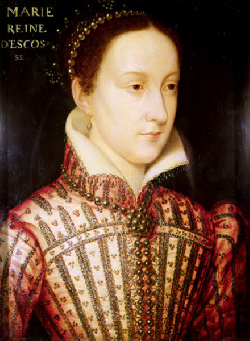
Mary, Queen of Scots Part 2
Scottish monarch
- Life
- 8 December 1542 - 8 February 1587
- Birthday
- December 8
- Length
- 10 parts
As Mary was an infant when she inherited the throne, Scotland was ruled by regents until she became an adult. From the outset, there were two different claims to the Regency: one from Catholic Cardinal Beaton, and the other from the Protestant Earl of Arran, who was next in line to the throne. Beaton's claim was based on a version of the late king's will that his opponents dismissed as a forgery.; John Knox claimed the king had signed a blank sheet of paper that Beaton had then filled in, while Arran claimed that Beaton had taken the dying king's hand in his own and traced out the signature (). The disputed will is printed in Arran, with the support of his friends and relations, became the regent until 1554 when Mary's mother managed to remove and succeed him.; ;
Treaty of Greenwich
King Henry VIII of England took the opportunity of the regency to propose marriage between Mary and his own son, Prince Edward, hoping for a union of Scotland and England. On 1 July 1543, when Mary was six months old, the Treaty of Greenwich was signed, which promised that at the age of ten Mary would marry Edward and move to England, where Henry could oversee her upbringing.; ; The treaty provided that the two countries would remain legally separate and that if the couple should fail to have children the temporary union would dissolve.; ; However, Cardinal Beaton rose to power again and began to push a pro-Catholic pro-French agenda, which angered Henry, who wanted to break the Scottish alliance with France.; Beaton wanted to move Mary away from the coast to the safety of Stirling Castle. Regent Arran resisted the move, but backed down when Beaton's armed supporters gathered at Linlithgow. The Earl of Lennox escorted Mary and her mother to Stirling on 27 July 1543 with 3,500 armed men. Mary was crowned in the castle chapel on 9 September 1543,; ; with "such solemnity as they do use in this country, which is not very costly" according to the report of Ralph Sadler and Henry Ray.Sadler to Henry VIII, 11 September 1543, quoted in ;
Shortly before Mary's coronation, Scottish merchants headed for France were arrested by Henry, and their goods impounded. The arrests caused anger in Scotland, and Arran joined Beaton and became a Catholic. The Treaty of Greenwich was rejected by the Parliament of Scotland in December.; ; The rejection of the marriage treaty and the renewal of the Auld Alliance between France and Scotland prompted Henry's "Rough Wooing", a military campaign designed to impose the marriage of Mary to his son. English forces mounted a series of raids on Scottish and French territory. In May 1544, the English Earl of Hertford (later Duke of Somerset) raided Edinburgh, and the Scots took Mary to Dunkeld for safety.;
In May 1546, Beaton was murdered by Protestant lairds,; ; and on 10 September 1547, nine months after the death of Henry VIII, the Scots suffered a heavy defeat at the Battle of Pinkie Cleugh. Mary's guardians, fearful for her safety, sent her to Inchmahome Priory for no more than three weeks, and turned to the French for help.; ;
The French king, Henry II, proposed to unite France and Scotland by marrying the young queen to his three-year-old son, the Dauphin Francis. On the promise of French military help, and a French dukedom for himself, Arran agreed to the marriage. In February 1548, Mary was moved, again for her safety, to Dumbarton Castle.; ; The English left a trail of devastation behind once more and seized the strategic town of Haddington. In June, the much awaited French help arrived at Leith to besiege and ultimately take Haddington. On 7 July 1548, a Scottish Parliament held at a nunnery near the town agreed to a French marriage treaty.;
Life in France
With her marriage agreement in place, five-year-old Mary was sent to France to spend the next thirteen years at the French court. The French fleet sent by Henry II, commanded by Nicolas de Villegagnon, sailed with Mary from Dumbarton on 7 August 1548 and arrived a week or more later at Roscoff or Saint-Pol-de-Léon in Brittany.; Jean de Saint Mauris to the Queen Dowager, 25 August 1548, quoted in ; She was accompanied by her own court including two illegitimate half-brothers, and the "four Marys", four girls her own age, all named Mary, who were the daughters of some of the noblest families in Scotland: Beaton, Seton, Fleming, and Livingston. Janet, Lady Fleming, who was Mary Fleming's mother and James V's half-sister, was appointed governess.;
Continue reading: part 3 of 10 →
