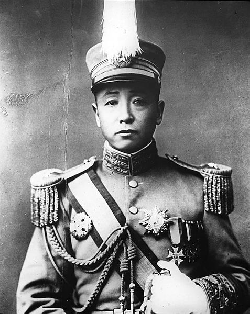
Zhang Zuolin Part 5
President of the Republic of China
- Life
- 19 March 1875 – 4 June 1928
- Birthday
- March 19
- Field
- State, Presidents
- Length
- 5 parts
In June 1926 Zhang had managed to capture Beijing. A year later he proclaimed himself as Grand Marshal of the Republic of China, and thus led China’s internationally recognized government. But the Nationalists, led by Chiang Kai-shek attacked his forces and in May 1928 the Fengtian Army had to retreat towards Beijing. In addition, Japan applied pressure on Zhang to leave Beijing and return to Manchuria, and underscored this by bringing reinforcements to Tianjin. Zhang left Beijing on 3 June 1928.
The next morning his train reached the outskirts of Shenyang. Here, the line passed through the Japanese operated South Manchuria Railroad. An officer of the Japanese Guandong (Kwantung) Army, Colonel Kōmoto Daisaku, had planted a bomb, which exploded when Zhang’s train passed under the viaduct. At the Tokyo War Crimes Tribunal in 1946, Okada Keisuke testified that Zhang was murdered because the Guandong (Kwantung) army was infuriated by his failure to stop Chiang’s army, which was backed by Moscow, then Tokyo’s strategic rival. For two weeks Zhang’s death was kept secret, while the scramble for power was decided. That is why, according to an announcement issued by the Fengtian Army, he officially died on 21 June 1928. Zhang was succeeded by the eldest son of his official wife, Zhang Xueliang.
The beginning of the end
After the disastrous defeat of 1922, Zhang had reorganized his Fengtian Army, started a training program and had bought new equipment like mobile radios and machine guns. In the autumn of 1924, fighting broke out again in Central China and Zhang saw an opportunity to capture North China and Beijing and become head of the Central Government. While most other warlord armies fought along the Yangtze River, Zhang attacked North China. The Second Zhili-Fengtian War had begun. In a surprise move a Zhili commander, Feng Yuxiang, toppled Cao Kun and took control of Beijing. He shared power with Zhang and both appointed the same Duan Qirui he had ousted in 1920. By August 1925, the Fengtian Army controlled four large provinces within the Great Wall (Zhili, where Beijing was located, but not Beijing itself, Shandong, Jiangsu, and Anhui). One unit even marched as far south as the city of Shanghai. But the military situation was so unstable, that Sun Chuanfang, a Zhili clique warlord whose sphere of influence extended along the Yangtze, managed to push back the Fengtian Army again. By November, Zhang held only a small corner of North China including a corridor connecting Beijing with Manchuria. Attacks on Beijing continued into the spring of 1926.
Manchuria was placed under martial law again, while its economy disintegrated under the burden of the insatiable war machine. Old taxes were increased and new taxes invented. Zhang demanded that more paper money was being printed out of step with silver reserves. A most serious crisis erupted when in November 1925 Guo Songling revolted and ordered his troops to turn back and march on Shenyang. The Japanese brought in reinforcements to protect their interests in Manchuria, but Zhang managed to put down the revolt in December. Even more seriously, Manchuria’s top civil official, Civil Governor Wang Yongjiang, realized that his work of nine years had been in vain. He left Shenyang in February 1926 and handed in his resignation. This time he didn’t react, when Zhang asked him to return. Wang died from kidney failure 1 November 1927.


