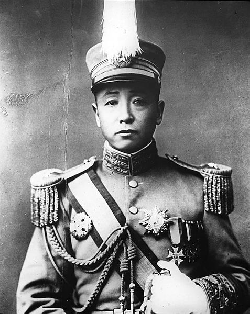
Zhang Zuolin Part 4
President of the Republic of China
- Life
- 19 March 1875 – 4 June 1928
- Birthday
- March 19
- Field
- State, Presidents
- Length
- 5 parts
How precarious the situation could develop at times was demonstrated by an outbreak of pneumonic plague in Hailar, a town at the western end of the Chinese Eastern Railway, in October 1920. Chinese troops were present in great number and turned railway quarantine into a farce. The soldiers set free some of their comrades who had been imprisoned as contacts, and they escaped to the mining town of Dalainor on the Amur River, where a quarter of the population succumbed. In the other direction all the towns along the Chinese Eastern Railway as far as Vladivostok were infected. In all, about 9,000 died, on the other hand only a few contacts were able to reach south Manchuria.Nathan, Carl F. (1967). Plague prevention and politics in Manchuria 1910-1931 Cambridge/Mass.: Harvard University Press. p. 66.
The Japanese posed more of a problem. After the Russo-Japanese war of 1904-05 they had gained two important outposts in south Manchuria: The Guandong (Kwantung) Leased Territory consisted of a peninsula in the southernmost part of Manchuria. It included the ice-free port of Dairen (known as Dalian in Chinese), which became the main link to Japan. Reaching northward from the colony the South Manchurian Railway passed through Shenyang (referred to as Mukden by the Japanese) linking up with the Chinese Eastern Railway in Changchun. The land on either side of the railway tracks remained extraterritorial, now being controlled by the Japanese Kwantung Army. This army maintained from 7,000 to 14,000 men in Manchuria tolerating and being tolerated by the Fengtian Army although Zhang kept up a war of words, playing on anti-Japanese sentiments in the Chinese public.
Regional development
In the following years Wang realized a far reaching development plan. He tried to bring more workers to the booming Manchurian economy. Most workers had come on a temporary basis, returning to their homes in North China in winter. Now the Manchurian government encouraged them to bring along women and children and settle permanently. They were eligible for reduced fares on all Chinese owned railways in Manchuria, received funds to build a dwelling and were promised total ownership after five years of continuous occupation. Rent for the land was canceled for the first years. Most were sent to the interior of Manchuria, where they reclaimed land for agriculture, or worked in forestry or mines. Between 1924 and 1929 the amount of land under tillage increased from 20 to 35 million acres (80,000 to 140,000 km²).
Manchuria’s economy boomed while chaos and uncertainty reigned in the rest of China. An especially ambitious project was to break the Japanese monopoly on cotton textiles by creating a large mill, which, much to Japan’s sorrow, succeeded. The government also invested in other enterprises, among them quite a number of Sino-Japanese companies. During this time the Fengtian Army successfully kept a lid on Manchuria’s many bandits. Various railway lines were built, among them the Shenyang-Hailong line, which opened in 1925. In 1924 Wang amalgamated three regional banks into the Official Bank of the Three Eastern Provinces and personally became its General Director. By this move he tried to create a development bank and at the same time to keep accurate records of military spending.
Footnotes
Manchuria’s economy collapses
In March 1926 a new civil governor was appointed. His only job was to supply the Fengtian Army with large amounts of money. He issued new provincial bonds, forcing business and local communities to purchase them. Early in 1927 he even entered into the opium trade by selling expensive licenses for the sale and use of opium. Bank reserves and railway revenues were plundered, while ever more paper notes were issued. The best indicator of Manchuria’s economic decline was the value of the Fengtian dollar (yuan), which had started on parity with the Japanese gold yen. In February 1928 a yen cost 40 yuan. In this winter Manchuria’s economy collapsed. Workers went on strike, hungry immigrants flooded back into Shenyang because they couldn’t find any work. Zhang Zuolin provided weapons to anti Guominjun Muslim rebels led by Ma Tingrang during the Muslim conflict in Gansu (1927–1930).
Continue reading: part 5 of 5 →


