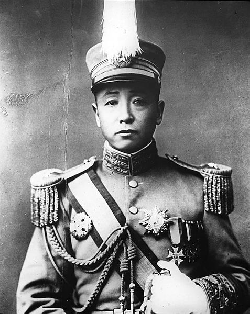
Zhang Zuolin Part 3
President of the Republic of China
- Life
- 19 March 1875 – 4 June 1928
- Birthday
- March 19
- Field
- State, Presidents
- Length
- 5 parts
Civil reform
At the beginning of the 1920s Zhang transformed Manchuria from an unimportant frontier region to one of the most prosperous parts of China. He had inherited a financially weak provincial government, e.g. in 1917 Fengtian faced ten outstanding loans from foreign-controlled consortia and banks totaling over 12 million yuan. Zhang chose Wang Yongjiang, who had served as head of a regional tax office, for the task of solving Fengtian’s financial problems. He was named Director of the Bureau of Finance.
A number of currencies were circulating in the province, as was the custom in China, and the paper notes issued by the provincial government had experienced a steady depreciation in value. Wang decided to switch to a silver standard and set the initial value of the new silver yuan equal to the Japanese gold yen, which was accepted throughout Korea and Manchuria. Much to the surprise of the Chinese the new currency even gained in value against the gold yen, although Japanese businessmen claimed that it was not backed up by sufficient silver reserves. Wang then used the newly gained credibility to introduce another note, the Fengtian dollar, which was not convertible into silver anymore. But it was accepted by the government for the payment of taxes, a sign that the government had faith in its own currency.
Next Wang turned to the chaotic tax collecting system. Because of his former job he was well acquainted with the abuses of the system and introduced a number of controls. The provincial government had also invested government funds in various enterprises, many of which were poorly managed. Wang ordered a total review of government sponsored firms. Since 1918 the revenues rose steadily, by 1921 all outstanding loans had been repaid and there was even a budget surplus. Wang was rewarded by being appointed as Civil Governor of Fengtian province while remaining Director of the Bureau of Finance. Zhang retained the title of Military Governor of Fengtian. Still, more than two thirds of the budget were allocated to the military.
Fortress Manchuria
In 1920, when he had passed his mid-40s, Zhang was the supreme ruler of Manchuria. The Central Government acknowledged this fact by appointing him to be Governor-General of the Three Eastern Provinces. He started to surround himself in luxury, built a chateau-style home near Shenyang, and had at least five wives (an accepted practice of any powerful or wealthy Chinese at the time). In 1925, his personal fortune was estimated at over 18 million yuan (roughly 2.6 million USD).
His power rested on the Fengtian Army, which was composed of about 100,000 men by 1922 and almost triple that number by the end of the decade. It had obtained large stocks of weapons left over from World War I, and even included naval units, an air force, and an armaments industry. Zhang integrated a large number of local militias in his Army, and thus prevented Manchuria from falling into the chaos which reigned in China proper at this time. Jilin province was ruled by a military governor, who was said to be a cousin of Zhang; Heilongjiang had its own regional warlord, who never displayed any ambitions outside the province.
Although Manchuria officially remained a part of the Republic of China, it became more or less an independent kingdom isolated from China by its geography and protected by the Fengtian Army. The only pass at Shanhaiguan, where the Great Wall meets the sea, could easily be closed. In a time when the Central Government was hardly able to pay the salaries of its civil servants, no more revenues were forwarded to Beijing. In 1922 Zhang took control of the only rail link, the Beijing-Shenyang Railway, north of the Great Wall and also kept these revenues. Only postal and customs revenues were continued to be sent to Beijing, because they had been pledged to the victorious foreign powers after the failed Boxer rebellion of 1900, and Zhang feared their intervention.
Japanese and Russian influences
Manchuria shared a long border with Russia, which had been weakened militarily after the October Revolution. The line of the Chinese Eastern Railway, which was under Russian control, ran through northern Manchuria, and the land immediately on either side of the tracks was considered to be Russian territory. From 1917 to about 1924 the new Communist government in Moscow was having such difficulties establishing itself in Siberia that often it wasn’t clear, who was in charge of operating the railway on the Russian side. Still, Zhang avoided a showdown, and after 1924, the Soviets managed to re-establish their dominance over the railroad.
Continue reading: part 4 of 5 →


