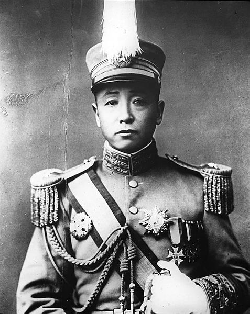
Zhang Zuolin
President of the Republic of China
- Life
- 19 March 1875 – 4 June 1928
- Birthday
- March 19
- Field
- State, Presidents
- Length
- 5 parts
Zhang Zuolin ( (1875–1928) was the warlord of Manchuria from 1916 to 1928 (see Warlord Era in China). He successfully invaded China proper in October 1924 in the Second Zhili-Fengtian War. He gained control of Peking, including China’s internationally recognized government, in April 1926. The economy of Manchuria, the basis of Zhang’s power, was overtaxed by his adventurism and collapsed in the winter of 1927-1928. Zhang was defeated by the Nationalist Kuomintang under Chiang Kai-shek in May 1928. He was killed by a bomb planted by a Japanese Kwantung Army officer on 4 June 1928.Hata 288 Although Zhang had been Japan’s proxy in China, Japanese militarists were infuriated by his failure to stop the advance of the Nationalists.
Zhang was fiercely anti Republican and supported restoration of the Qing dynasty. His nicknames include the "Old Marshal" (大帥, P: Dàshuài, W: Ta-shuai), "Rain Marshal" (雨帥, P: Yǔshuài, W: Yü-shuai) and "Mukden Tiger". The American press referred to him as "Marshal Chang Tso-lin, Tuchun of Manchuria.""War?" Time Sept. 8, 1924
War in north China
In the summer of 1920 Zhang made a foray into north China on the other side of the Great Wall trying to topple Duan Qirui, the leading warlord of Beijing. He did this by supporting another warlord, Cao Kun, with troops, and they both successfully ousted Duan. As a reward Zhang was granted control over most of inner Mongolia to the west of Manchuria. Zhang had become a figure of national prominence. But he was confronted by Wu Peifu, a divisional commander of the North China Zhili clique, which was based in the province of Zhili that surrounded Beijing. In spring 1922 Zhang personally took the position of Commander-in-Chief of the Fengtian Army, and on 19 April his forces entered into China proper. Fighting started three days later, and on 4 May they were seriously defeated by the Zhili Army in what came to be known as the First Zhili-Fengtian War. 3,000 troops had been killed and 7,000 wounded, so that Zhang’s units had to retreat to Shanhaiguan Pass. Zhili forces were in control of Beijing, Zhang’s image as a national leader had been destroyed, and he reacted by declaring Manchuria independent from Beijing in May 1922.
Manchuria’s top civil official, Wang, left Shenyang on 22 June for Japanese controlled Dalian allegedly for treatment of an eye infection that troubled him. From there he challenged Zhang by demanding restrictions to military spending and a complete control over civil affairs. Zhang, one of China’s most feared warlords, gave in, lifted martial law and agreed to a separation of civil and military administration in all of the three provinces. Wang returned on 6 August thereby guaranteeing Manchuria’s continued stability.
Origins
Early life
Zhang was born in 1875 in Haicheng county in southern Fengtian province. He was born to poor parents, who can hardly have offered him any formal education, and the only non-military trade that he learned in his lifetime was a small amount of veterinary science. His grandfather had come to the northeast after fleeing a famine in Zhili (modern Hebei) in 1821.
Growing up as a poor village urchin, Zhang was known by the nickname "pimple". He spent his early youth hunting, fishing, and brawling.Bonavia 63 He hunted hares in the Manchurian countryside to help feed his family. In appearance he was always thin and rather short.
When he became old enough to seek work, Zhang worked at a stable in an inn, where he became familiar with many bandit-gangs that infested Manchuria at the time. As early as 1896 Zhang himself was a member of a well-known bandit gang. In one version of Zhang Zuolin’s beginnings as a warlord, during a hunting trip he spotted a wounded bandit (Honghuzi) on horseback, killed him, took his horse, and became a bandit himself. By his late 20s he had formed a small personal army, acquiring something of a Robin Hood reputation.Behr 145
Continue reading: part 2 of 5 →


