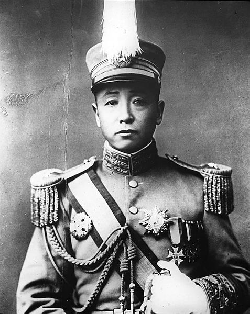
Zhang Zuolin Part 2
President of the Republic of China
- Life
- 19 March 1875 – 4 June 1928
- Birthday
- March 19
- Field
- State, Presidents
- Length
- 5 parts
In 1900 the Boxer Rebellion broke out, and Zhang’s gang joined the imperial army. In peacetime, Zhang hired his men out as escorts for travelling merchants. In the Russo-Japanese war of 1904-05, the Japanese Army employed Zhang and his men as mercenaries. At the end of the Qing dynasty, Zhang managed to have his men recognized as a regiment of the regular Chinese army, patrolling the borders of Manchuria and suppressing other bandit gangs. Dr. Louis Livingston Seaman met Zhang during the Russo-Japanese War, and took several photographs of him and his troops as well as writing an account of his journey.LONDON SIDNEY APPLETON COPYRIGHT, 1904, BY D. APPLETON AND COMPANY Original from the University of California Digitized Nov 21, 2007LONDON SIDNEY APPLETON COPYRIGHT, 1904, BY D. APPLETON AND COMPANY Original from the University of California Digitized Nov 21, 2007
Growth of power in Manchuria
During the 1911 Xinhai Revolution, some military commanders wanted to declare independence for Manchuria, but the pro-Manchu governor used Zhang’s regiment to set up a "Manchurian People’s Peacekeeping Council", intimidating would-be rebels and revolutionaries. For his efforts in preventing civil disturbance and revolution, Zhang was named the Vice Minister of Military Affairs.Bonavia 63-64
On January 1, 1912, Sun Yat-sen became the first President of the Republic of China in Nanjing. Yuan Shikai, operating out of Beijing, sent other northern military commanders a series of telegrams, advising them to oppose Sun’s administration. To gain Zhang’s loyalty, Yuan sent Zhang a large shipment of military provisions; Zhang sent Yuan an enormous (and costly) ginseng root in return to symbolize their friendship. Zhang then murdered a number of leading figures in his base city of Shenyang (then known as "Mukden"), and was rewarded with a series of impressive-sounding titles by the nearly defunct Manchu court. When it became obvious to Zhang that Yuan would usurp control of the central government, Zhang endorsed Yuan’s rule over that of either Sun or the Manchus. After Zhang put down a rebellion in June 1912, Yuan raised him to the rank of Lieutenant-General. In 1913 Yuan attempted to move Zhang away from Manchuria by having Zhang transferred to Mongolia, but Zhang reminded Yuan of his successful efforts to keep local order, and refused.Bonavia 64-65
In 1915, when it became clear that Yuan intended to declare himself emperor, Zhang was one of the few officials who supported Yuan. Besides political opportunism, Zhang probably recognizing that Yuan’s monarchy would likely be short, and that it could always be attacked later. Because Zhang Zuolin’s main rival for power in Manchuria, Zhang Xiluan, when asked about Yuan’s ambitions, had told Yuan to "think about it a bit more", Zhang Xiluan was recalled to Beijing, while Zhang Zuolin was promoted.Bonavia 66
In March 1916, after many southern provinces revolted against Yuan Shikai’s government, Zhang supported Yuan but expelled a local military governor sent by Duan Qirui to replace him, with some support from local Japanese officers in the Kwangtung Army. Beijing accepted Zhang’s authority, and Yuan appointed Zhang superintendent of military affairs in Liaoning (known as "Fengtian" until 1929). After Yuan died, in June 1916, the new central government named Zhang both military and civil governor of Liaoning, the essential components of a successful warlord.Bonavia 66-67
Zhang, a monarchist, had always remained cordial with Puyi, the last Emperor of China, and had sent him a gift of £1,600 for his wedding as a token of loyalty. In 1917 he plotted with Zhang Xun, a Qing-loyalist general, to restore the abdicated Puyi to the throne.Behr 105 After Zhang Xun rebelled, Zhang Zuolin remained neutral, and actually supported Duan Qirui in suppressing Zhang Xun after it became clear that Duan would win. Zhang was able to absorb soldiers of nearby commanders who had been linked to the rebellion, increasing his own power. Zhang intervened and took control of China’s northernmost province, Heilongjiang, after a rebellion there forced the local governor to flee. Because the governor of Jilin had been linked to the attempt to restore the monarchy, Zhang had allies from Jilin successfully agitate for the governor’s dismissal in Beijing. By 1918 Zhang’s control of Manchuria was complete, except for the small areas held by the Japanese Empire.Bonavia 67-68
Continue reading: part 3 of 5 →


