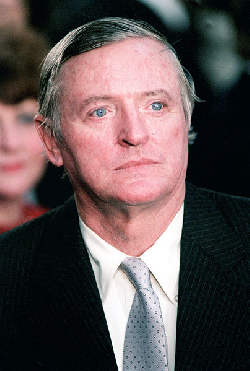
William F. Buckley, Jr. Part 8
Author, Commentator, Television Personality
- Life
- 24 November 1925 - 27 February 2008
- Birthday
- November 24
- Length
- 10 parts
Linguistic expertise
Buckley was well known for his command of language.See Schmidt, Julian. (June 6, 2005) National Review Notes & asides. (Letter to the Editor) Volume 53; Issue 2. Pg. 17. ("Dear Mr. Buckley: You can call off the hunt for the elusive "encephalophonic". I have it cornered in Webster's Third New International Dictionary, where the noun "encephalophone" is defined as "an apparatus that emits a continuous hum whose pitch is changed by interference of brain waves transmitted through oscillators from electrodes attached to the scalp and that is used to diagnose abnormal brain functioning." I knew right where to look, because you provoked my search for that word a generation ago, when I first (and not last) encountered it in one of your books. If it was used derisively about you, I can only infer that the reviewer's brain was set a-humming by a) his failure to follow your illaqueating (ensnaring) logic, b) his dizzied awe at your manifold talents, and/or c) his inability to distinguish lexiphanicism (the use of pretentious words) from lectio divina. I say, keep it up. We could all do with more brain vibrations.") He came late to formal instruction in English, not learning it until he was seven years old and having earlier learned Spanish and French.Early chapters recount his early education and mastery of languages. Michelle Tsai in Slate says that he spoke English with an idiosyncratic accent: something between an old-fashioned, upper class Mid-Atlantic accent, and British Received Pronunciation, with a Southern drawl.
Rhetoric
Epstein (1972) argues that liberals were especially fascinated by Buckley, and often wanted to debate him, in part because his ideas resembled their own, for Buckley typically formulated his arguments in reaction to left-liberal opinion, rather than being founded on conservative principles that were alien to the liberals.Joseph Epstein, "The Politics of William Buckley: Conservative Ideologue as Liberal Celebrity", Dissent, Oct 1972, Vol. 19 Issue 4, pp 602–61
Appel (1992) argues from rhetorical theory that Buckley's essays are often written in "low" burlesque in the manner of Samuel Butler's satirical poem "Hudibras". Considered as drama, such discourse features black-and-white disorder, a guilt-mongering logician, distorted clownish opponents, limited scapegoating, and a self-serving redemption.Edward C. Appel, "Burlesque drama as a rhetorical genre: The hudibrastic ridicule of William F. Buckley, Jr.," Western Journal of Communication, Summer 1996, Vol. 60 Issue 3, pp 269–284
Lee (2008) argues that Buckley introduced a new rhetorical style that conservatives often tried to emulate. The "gladiatorial style", as Lee calls it, is flashy and combative, filled with sound bites, and leads to an inflammatory drama. As conservatives encountered Buckley's arguments about government, liberalism and markets, the theatrical appeal of Buckley's gladiatorial style inspired conservative imitators, becoming one of the principal templates for conservative rhetoric.Michael J. Lee, "WFB: The Gladiatorial Style and the Politics of Provocation," Rhetoric and Public Affairs, Summer 2010, Vol. 13 Issue 2, pp 43–76
National Review
Examining postwar conservative intellectual history, Kim Phillips-Fein writes:
The most influential synthesis of the subject remains George H. Nash's The Conservative Intellectual Tradition since 1945.... He argued that postwar conservatism brought together three powerful and partially contradictory intellectual currents that previously had largely been independent of each other: libertarianism, traditionalism, and anticommunism. Each particular strain of thought had predecessors earlier in the twentieth (and even nineteenth) centuries, but they were joined in their distinctive postwar formulation through the leadership of William F. Buckley Jr. and National Review. The fusion of these different, competing, and not easily reconciled schools of thought led to the creation, Nash argued, of a coherent modern Right."Kim Phillips-Fein, "Conservatism: A State of the Field," Journal of American History, (Dec. 2011) 98#3 pp 723–743, quote p. 729George H. Nash, The Conservative Intellectual Tradition since 1945 (1976)Continue reading: part 9 of 10 →Also born on November 24
 Alexander ParrisNovember 24, 1790 - June 16, 1852
 Alexander Suvorov24 November 1730 – 18 May 1800Alfonso Lastras RamírezNovember 24, 1924 - December 25, 1999Anna Louise StrongNovember 24, 1885 - March 29, 1970Bejaratana Rajasuda24 November 1925 - 27 July 2011