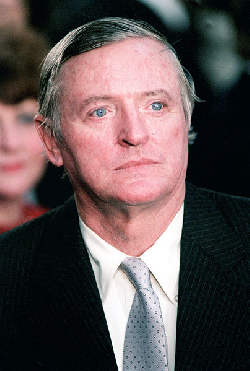
William F. Buckley, Jr. Part 4
Author, Commentator, Television Personality
- Life
- 24 November 1925 - 27 February 2008
- Birthday
- November 24
- Length
- 10 parts
In McCarthy and his Enemies he asserted that "McCarthyism... is a movement around which men of good will and stern morality can close ranks."
Buckley worked as an editor for The American Mercury in 1951 and 1952, but left after perceiving newly emerging anti-Semitic tendencies in the magazine.
Death
Buckley died at his home in Stamford, Connecticut, on February 27, 2008. Initially, it was reported that he was found dead at his desk in his study, a converted garage. "He died with his boots on", his son Christopher Buckley said, "after a lifetime of riding pretty tall in the saddle." Subsequently, however, in his 2009 book Losing Mum and Pup: A Memoir, Christopher Buckley admitted that this account was an embellishment on his part: his father had actually been found lying on the floor of his study after suffering a fatal heart attack. At the time of his death, he had been suffering from emphysema and diabetes. In a December 3, 2007 column, Buckley commented on the cause of his emphysema, citing his lifelong habit of smoking tobacco, despite endorsing a legal ban of it.
Notable members of the Republican political establishment paying tribute to Buckley included President George W. Bush, former Speaker of the House of Representatives Newt Gingrich, and former First Lady Nancy Reagan. Bush said of Buckley, "[h]e influenced a lot of people, including me. He captured the imagination of a lot of people." Gingrich added, "Bill Buckley became the indispensable intellectual advocate from whose energy, intelligence, wit, and enthusiasm the best of modern conservatism drew its inspiration and encouragement... Buckley began what led to Senator Barry Goldwater and his Conscience of a Conservative that led to the seizing of power by the conservatives from the moderate establishment within the Republican Party. From that emerged Ronald Reagan." Reagan's widow, Nancy, commented, "Ronnie valued Bill's counsel throughout his political life, and after Ronnie died, Bill and Pat were there for me in so many ways."
Works
Spy novelist
In 1975, Buckley recounted being inspired to write a spy novel by Frederick Forsyth's The Day of the Jackal: "...If I were to write a book of fiction, I'd like to have a whack at something of that nature." He went on to explain that he was determined to avoid the moral ambiguity of Graham Greene and John le Carré. Buckley wrote the 1976 spy novel Saving the Queen, featuring Blackford Oakes as a rule-bound CIA agent, based in part on his own CIA experiences. Over the next 30 years, he would write another ten novels featuring Oakes. New York Times critic Charlie Rubin wrote that the series "at its best, evokes John O'Hara in its precise sense of place amid simmering class hierarchies"., Charlie Rubin, The New York Times, July 17, 2005 Stained Glass, second in the series, won a 1980 National Book Award in the one-year category Mystery (paperback). . National Book Foundation. Retrieved 2012-02-28. (With essay by Harold Augenbraum from the Awards 60-year anniversary blog.) From 1980 to 1983 in National Book Award history there were dual awards for hardcover and paperback books in many categories. Most all of the paperback award-winners were reprints, including this one.
Buckley was particularly concerned about the view that what the CIA and the KGB were doing was morally equivalent. As he wrote in his memoirs, "To say that the CIA and the KGB engage in similar practices is the equivalent of saying that the man who pushes an old lady into the path of a hurtling bus is not to be distinguished from the man who pushes an old lady out of the path of a hurtling bus: on the grounds that, after all, in both cases someone is pushing old ladies around.Linda Bridges and John R. Coyne, Strictly Right: William F. Buckley, Jr. and the American conservative movement (2007) p. 182
Buckley began doing his writing work on computers in the 1980s, and according to his son, he developed an almost fanatical loyalty to the word processing application WordStar, installing it on every new PC he got despite its growing obsolescence over the years. He still used it to write his last novel, and when asked why he continued using something so outdated, he would answer "They say there's better software, but they also say there's better alphabets."
Continue reading: part 5 of 10 →Also born on November 24
 Alexander ParrisNovember 24, 1790 - June 16, 1852
 Alexander Suvorov24 November 1730 – 18 May 1800Alfonso Lastras RamírezNovember 24, 1924 - December 25, 1999Anna Louise StrongNovember 24, 1885 - March 29, 1970Bejaratana Rajasuda24 November 1925 - 27 July 2011