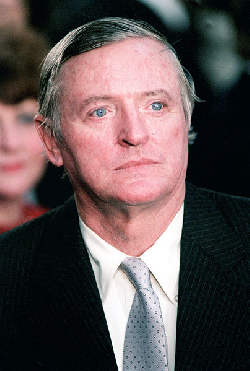
William F. Buckley, Jr. Part 10
Author, Commentator, Television Personality
- Life
- 24 November 1925 - 27 February 2008
- Birthday
- November 24
- Length
- 10 parts
In 2004, he backtracked, saying, "the point I made about white cultural supremacy was sociological" and linking his usage of the word "Advancement" to its usage in the name NAACP, continued, "The call for the 'advancement' of colored people presupposes they are behind. Which they were, in 1958, by any standards of measurement." Buckley changed his views and by the mid-1960s renounced racism. This change was caused in part because he became appalled at the violence used by white supremacists during the Civil Rights Movement, and in part because of the influence of friends like Garry Wills, who confronted Buckley on the morality of his politics.
In the late 1960s, Buckley disagreed strenuously with segregationist George Wallace, who ran in Democratic primaries (1964 and 1972) and made an independent run for president in 1968. Buckley later said it was a mistake for National Review to have opposed the civil rights legislation of 1964–65. He later grew to admire Martin Luther King, Jr. and supported creation of a Martin Luther King, Jr. Day national holiday for him.Tanenhaus, Sam, , Paper Cuts blog at The New York Times website, February 27, 2008. During the 1950s, Buckley had worked to remove anti-Semitism from the conservative movement and barred holders of those views from working for National Review.
In 1962, Buckley denounced Robert W. Welch, Jr., and the John Birch Society, in National Review, as "far removed from common sense" and urged the GOP to purge itself of Welch's influence.William F. Buckley, Jr., "Goldwater, the John Birch Society, and Me".
Democracy and Communism
Buckley's opposition to Communism extended to support of the overthrow and replacement of leftist governments by non-democratic forces. Buckley supported Spanish dictator General Francisco Franco who led the rightist military rebellion in its military defeat of the democratically-elected Spanish Republic. He called Franco "an authentic national hero," applauding his overthrow of Spanish Republican "visionaries, ideologues, Marxists and nihilists."National Review, 10/ 26/57 He supported the military dictatorship of General Augusto Pinochet that led the 1973 coup that overthrew Chilean president Salvador Allende's democratically-elected Marxist government, referring to Allende as "a president who was defiling the Chilean constitution and waving proudly the banner of his friend and idol, Fidel Castro."National Review, November 23, 1998
Religion
Buckley was raised a Catholic, and was a member of the Knights of Malta.Phelan, Matthew (2011-02-28) , Salon.com He described his faith by saying, "I grew up, as reported, in a large family of Catholics without even a decent ration of tentativeness among the lot of us about our religious faith."Buckley, Nearer, My God. p241 As a child, he attended St. John's, Beaumont, a boarding school in Old Windsor, for a time before the outbreak of World War II. Later, he attended Millbrook, a Protestant school, but was permitted to attend Catholic Mass at a nearby church. As a youth, he became aware of anti-Catholic bias in the United States, particularly American Freedom and Catholic Power, a Paul Blanshard book that accused American Catholics of having 'divided loyalties.'
The release of his first book, God and Man at Yale, was met with some specific criticism pertaining to his Catholicism. McGeorge Bundy, dean of Harvard at the time, wrote in The Atlantic that "it seems strange for any Roman Catholic to undertake to speak for the Yale religious tradition." Henry Sloan Coffin, a Yale trustee, accused Buckley's book of "being distorted by his Roman Catholic point of view" and stated that Buckley "should have attended Fordham or some similar institution."Buckley, Nearer, My God p. 30
In his 1997 book Nearer, My God, he condemned what he viewed as "the Supreme Court's war against religion in the public school," and argued that Christian faith was being replaced by "another God...multiculturalism."Buckley, Nearer, My God. p37 As an adult, Buckley regularly attended the traditional Latin Mass in Connecticut. He disapproved of the liturgical reforms following the Vatican II Council. Buckley also revealed an interest in the writings and revelations of the 20th Century Italian mystic Maria Valtorta. In his spiritual memoir Buckley reproduced Valtorta's detailed accounts of Jesus Christ's crucifixion, which were based on Valtorta's visionary experiences of Christ and the mystical revelations she reported experiencing between the years 1943–47, being shown Jesus' life in 1st-century Palestine and recording the visions in her book The Poem of the Man God.
Also born on November 24
 Alexander ParrisNovember 24, 1790 - June 16, 1852
 Alexander Suvorov24 November 1730 – 18 May 1800Alfonso Lastras RamírezNovember 24, 1924 - December 25, 1999Anna Louise StrongNovember 24, 1885 - March 29, 1970Bejaratana Rajasuda24 November 1925 - 27 July 2011