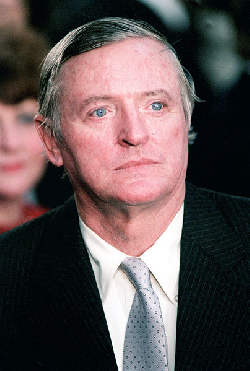
William F. Buckley, Jr. Part 2
Author, Commentator, Television Personality
- Life
- 24 November 1925 - 27 February 2008
- Birthday
- November 24
- Length
- 10 parts
To relieve traffic congestion, Buckley proposed charging cars a fee to enter the central city, and a network of bike lanes. He opposed a civilian review board for the New York Police Department, which Lindsay had recently introduced to control police corruption and install community policing. Buckley finished third with 13.4% of the vote, possibly having inadvertently aided Lindsay's election by instead taking votes from Democratic candidate Abe Beame.
Firing Line
For many Americans, Buckley's erudition on his weekly PBS show Firing Line (1966–1999) was their primary exposure to him.
Throughout his career as a media figure, Buckley had received much criticism, largely from the American left but also from certain factions on the right, such as the John Birch Society and its second president, Larry McDonald, as well as from Objectivists.
In 1953–1954, long before he founded Firing Line, Buckley was an occasional panelist on the conservative public affairs program, Answers for Americans, broadcast on ABC and based on source material from the H. L. Hunt-supported publication Facts Forum.
Feud with Gore Vidal
Buckley appeared in a series of televised debates with Gore Vidal during the 1968 Democratic National Convention in Chicago. In their penultimate debate on August 28 of that year, the two disagreed over the actions of the city police and the protesters at the ongoing convention. In reference to the response of the police involved in supposedly taking down a Viet Cong flag, moderator Howard K. Smith asked whether raising a Nazi flag during the Second World War would have elicited a similar response. Vidal responded that people were free to state their political views as they saw fit, whereupon Buckley interrupted and noted that people were free to speak their views but others were also free to ostracize them for holding those views, noting that in the U.S. during the Second World War "some people were pro-Nazi and they were well treated by those who ostracized them – and I'm for ostracizing people who egg on other people to shoot American Marines and American soldiers. I know you [Vidal] don't care because you have no sense of identification with . . .". Vidal then interjected that "the only sort of pro- or crypto-Nazi I can think of is yourself", whereupon Smith interjected, "Now let's not call names." Buckley, visibly angered, rose several inches from his seat and replied, "Now listen, you queer, stop calling me a crypto-Nazi or I'll sock you in your goddamn face, and you'll stay plastered." Buckley was to later apologize in print for having called Vidal a "queer" in a burst of anger rather than in a clinical context, but also reiterated his distaste for Vidal as an "evangelist for bisexuality": "The man who in his essays proclaims the normalcy of his affliction, and in his art the desirability of it, is not to be confused with the man who bears his sorrow quietly. The addict is to be pitied and even respected, not the pusher."Esquire (August 1969), p. 132.
This feud continued the following year in the pages of Esquire, which commissioned essays from both Buckley and Vidal on the television incident. Buckley's essay "On Experiencing Gore Vidal", was published in the August 1969 issue, and led Vidal to sue for libel. The court threw out Vidal's case. Vidal's September essay in reply, "A Distasteful Encounter with William F. Buckley", was similarly litigated by Buckley. In it Vidal strongly implied that, in 1944, Buckley and unnamed siblings had vandalized a Protestant church in their Sharon, Connecticut, hometown after the pastor's wife had sold a house to a Jewish family. Buckley sued Vidal and Esquire for libel; Vidal counter-claimed for libel against Buckley, citing Buckley's characterization of Vidal's novel Myra Breckenridge as pornography. Both cases were dropped, with Buckley settling for court costs paid by Vidal, while Vidal absorbed his own court costs. Buckley also received an editorial apology in the pages of Esquire as part of the settlement.
Continue reading: part 3 of 10 →Also born on November 24
 Alexander ParrisNovember 24, 1790 - June 16, 1852
 Alexander Suvorov24 November 1730 – 18 May 1800Alfonso Lastras RamírezNovember 24, 1924 - December 25, 1999Anna Louise StrongNovember 24, 1885 - March 29, 1970Bejaratana Rajasuda24 November 1925 - 27 July 2011