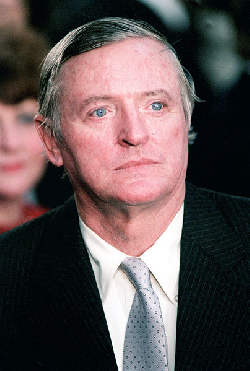
William F. Buckley, Jr.
Author, Commentator, Television Personality
- Life
- 24 November 1925 - 27 February 2008
- Birthday
- November 24
- Length
- 10 parts
William Frank Buckley, Jr."William Francis" in the editorial obituary "Up From Liberalism" The Wall Street Journal February 28, 2008, p. A16; Martin, Douglas, "William F. Buckley Jr., 82, Dies; Sesquipedalian Spark of Right", obituary, New York Times, February 28, 2008, which reported that his parents preferred "Frank", which would make him a "Jr.", but at his christening, the priest "insisted on a saint's name, so Francis was chosen. When the younger William Buckley was 5, he asked to change his middle name to Frank and his parents agreed. At that point, he became William F. Buckley Jr. ." (November 24, 1925 – February 27, 2008) was a conservative American authorItalie, Hillel via Associated Press. , San Francisco Chronicle, February 27, 2008. Accessed January 18, 2009. and commentator. He founded the political magazine National Review in 1955, which had a major impact in stimulating the conservative movement. He hosted 1,429 episodes of the television show Firing Line from 1966 until 1999, where he became known for his transatlantic accent and wide vocabulary.The Wall Street Journal February 28, 2008, p. A16 He also wrote a nationally syndicated newspaper column, and wrote numerous spy novels.For complete, searchable texts see .
George H. Nash, a historian of the modern American Conservative movement, states that Buckley was "arguably the most important public intellectual in the United States in the past half century... For an entire generation, he was the preeminent voice of American conservatism and its first great ecumenical figure." Buckley's primary contribution to politics was a fusion of traditional American political conservatism with laissez-faire economic theory and anti-communism, laying groundwork for the new American conservatism of U.S. presidential candidate Barry Goldwater and President Ronald Reagan.
Buckley wrote God and Man at Yale (1951) and over 50 other books on writing, speaking, history, politics and sailing, including a series of novels featuring CIA agent Blackford Oakes. Buckley referred to himself as either a libertarian or conservative.C-SPAN Booknotes October 23, 1993Buckley, William F., Jr. Happy Days Were Here Again: Reflections of a Libertarian Journalist, Random House, ISBN 0-679-40398-1, 1993. He resided in New York City and Stamford, Connecticut. He was a practicing Catholic, regularly attending the traditional Latin Mass in Connecticut.
In the political firing line
Young Americans for Freedom and Barry Goldwater
In 1960, Buckley helped form Young Americans for Freedom (YAF). YAF was guided by principles Buckley called, "The Sharon Statement". Buckley was proud of the successful campaign of his elder brother, Jim Buckley, on the Conservative Party ticket to capture the U.S. Senate seat from New York State held by incumbent Republican Charles Goodell in 1970, giving very generous credit to the activist support of the New York State chapter of Y.A.F. Buckley served one term in the Senate, then was defeated by Democrat Daniel Patrick Moynihan in 1976.Judis, William F. Buckley, Jr.: Patron Saint of the Conservatives pp 185–98, 311
In 1963–64, Buckley mobilized support for the candidacy of Arizona Senator Barry Goldwater, first for the Republican nomination against New York Governor Nelson Rockefeller and then for the Presidency. Buckley used National Review as a forum for mobilizing support for Goldwater.Judis, William F. Buckley, Jr.: Patron Saint of the Conservatives ch 10
On The Right
Buckley's column On The Right was syndicated by Universal Press Syndicate beginning in 1962. From the early 1970s, his twice-weekly column was distributed to more than 320 newspapers across the country.
Mayoral candidacy
In 1965, Buckley ran for mayor of New York City as the candidate for the new Conservative Party. He ran to restore momentum to the conservative cause in the wake of Goldwater's defeat.Jonathan Schoenwald, A Time for Choosing: The Rise of Modern American Conservatism (2002) pp 162–89 He tried to take votes away from the relatively liberal Republican candidate and fellow Yale alumnus John Lindsay, who later became a Democrat. Buckley did not expect to win; indeed, when asked what he would do if he won the race, Buckley responded, "Demand a recount.") and used an unusual campaign style; during one televised debate with Lindsay, Buckley declined to use his allotted rebuttal time and instead replied, "I am satisfied to sit back and contemplate my own former eloquence."
Continue reading: part 2 of 10 →Also born on November 24
 Alexander ParrisNovember 24, 1790 - June 16, 1852
 Alexander Suvorov24 November 1730 – 18 May 1800Alfonso Lastras RamírezNovember 24, 1924 - December 25, 1999Anna Louise StrongNovember 24, 1885 - March 29, 1970Bejaratana Rajasuda24 November 1925 - 27 July 2011