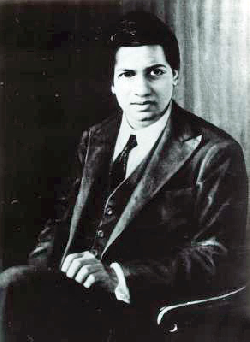
Srinivasa Ramanujan Part 9
Mathematician
- Life
- 22 December 1887 - 26 April 1920
- Birthday
- December 22
- Length
- 10 parts
Personality and spiritual life
Ramanujan has been described as a person with a somewhat shy and quiet disposition, a dignified man with pleasant manners. He lived a rather Spartan life while at Cambridge. Ramanujan's first Indian biographers describe him as rigorously orthodox. Ramanujan credited his acumen to his family Goddess, Namagiri of Namakkal. He looked to her for inspiration in his work, and claimed to dream of blood drops that symbolised her male consort, Narasimha, after which he would receive visions of scrolls of complex mathematical content unfolding before his eyes. He often said, "An equation for me has no meaning, unless it represents a thought of God."
Hardy cites Ramanujan as remarking that all religions seemed equally true to him. Hardy further argued that Ramanujan's religiousness had been romanticised by Westerners and overstated—in reference to his belief, not practice—by Indian biographers. At the same time, he remarked on Ramanujan's strict observance of vegetarianism.
Other mathematicians' views of Ramanujan
Hardy said : "The limitations of his knowledge were as startling as its profundity. Here was a man who could work out modular equations and theorems... to orders unheard of, whose mastery of continued fractions was... beyond that of any mathematician in the world, who had found for himself the functional equation of the zeta function and the dominant terms of many of the most famous problems in the analytic theory of numbers; and yet he had never heard of a doubly periodic function or of Cauchy's theorem, and had indeed but the vaguest idea of what a function of a complex variable was...". When asked about the methods employed by Ramanujan to arrive at his solutions, Hardy said that they were "arrived at by a process of mingled argument, intuition, and induction, of which he was entirely unable to give any coherent account.". Retrieved 2 December 2010. He also stated that he had "never met his equal, and can compare him only with Euler or Jacobi."
Quoting K. Srinivasa Rao, "As for his place in the world of Mathematics, we quote Bruce C. Berndt: 'Paul Erdős has passed on to us Hardy's personal ratings of mathematicians. Suppose that we rate mathematicians on the basis of pure talent on a scale from 0 to 100, Hardy gave himself a score of 25, J.E. Littlewood 30, David Hilbert 80 and Ramanujan 100.'"
Professor Bruce C. Berndt of the University of Illinois, during a lecture at IIT Madras in May 2011, stated that over the last 40 years, as nearly all of Ramanujan's theorems have been proven right, there had been a greater appreciation of Ramanujan's work and brilliance. Further, he stated Ramanujan's work was now pervading many areas of modern mathematics and physics.
In his book Scientific Edge, noted physicist Jayant Narlikar spoke of "Srinivasa Ramanujan, discovered by the Cambridge mathematician Hardy, whose great mathematical findings were beginning to be appreciated from 1915 to 1919. His achievements were to be fully understood much later, well after his untimely death in 1920. For example, his work on the highly composite numbers (numbers with a large number of factors) started a whole new line of investigations in the theory of such numbers."
During his lifelong mission in educating and propagating mathematics among the school children in India, Nigeria and elsewhere, P.K. Srinivasan has continually introduced Ramanujan's mathematical works.
Mathematical achievements
In mathematics, there is a distinction between having an insight and having a proof. Ramanujan's talent suggested a plethora of formulae that could then be investigated in depth later. It is said that Ramanujan's discoveries are unusually rich and that there is often more to them than initially meets the eye. As a by-product, new directions of research were opened up. Examples of the most interesting of these formulae include the intriguing infinite series for π, one of which is given below
Continue reading: part 10 of 10 →

