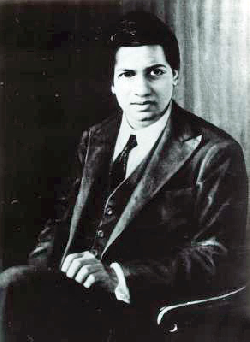
Srinivasa Ramanujan Part 4
Mathematician
- Life
- 22 December 1887 - 26 April 1920
- Birthday
- December 22
- Length
- 10 parts
The first result had already been determined by a mathematician named Bauer. The second one was new to Hardy, and was derived from a class of functions called a hypergeometric series which had first been researched by Leonhard Euler and Carl Friedrich Gauss. Compared to Ramanujan's work on integrals, Hardy found these results "much more intriguing". After he saw Ramanujan's theorems on continued fractions on the last page of the manuscripts, Hardy commented that the "[theorems] defeated me completely; I had never seen anything in the least like them before". He figured that Ramanujan's theorems "must be true, because, if they were not true, no one would have the imagination to invent them". Hardy asked a colleague, J. E. Littlewood, to take a look at the papers. Littlewood was amazed by the mathematical genius of Ramanujan. After discussing the papers with Littlewood, Hardy concluded that the letters were "certainly the most remarkable I have received" and commented that Ramanujan was "a mathematician of the highest quality, a man of altogether exceptional originality and power".Hardy (June 1920), pp494–495. One colleague, E. H. Neville, later commented that "not one [theorem] could have been set in the most advanced mathematical examination in the world".
On 8 February 1913, Hardy wrote a letter to Ramanujan, expressing his interest for his work. Hardy also added that it was "essential that I should see proofs of some of your assertions".Letter, Hardy to Ramanujan, 8 February 1913. Before his letter arrived in Madras during the third week of February, Hardy contacted the Indian Office to plan for Ramanujan's trip to Cambridge. Secretary Arthur Davies of the Advisory Committee for Indian Students met with Ramanujan to discuss the overseas trip.Letter, Ramanujan to Hardy, 22 January 1914. In accordance with his Brahmin upbringing, Ramanujan refused to leave his country to "go to a foreign land". Meanwhile, Ramanujan sent a letter packed with theorems to Hardy, writing, "I have found a friend in you who views my labour sympathetically."Letter, Ramanujan to Hardy, 27 February 1913, Cambridge University Library.
To supplement Hardy's endorsement, a former mathematical lecturer at Trinity College, Cambridge, Gilbert Walker, looked at Ramanujan's work and expressed amazement, urging him to spend time at Cambridge. As a result of Walker's endorsement, B. Hanumantha Rao, a mathematics professor at an engineering college, invited Ramanujan's colleague Narayana Iyer to a meeting of the Board of Studies in Mathematics to discuss "what we can do for S. Ramanujan". The board agreed to grant Ramanujan a research scholarship of 75 rupees per month for the next two years at the University of Madras. While he was engaged as a research student, Ramanujan continued to submit papers to the Journal of the Indian Mathematical Society. In one instance, Narayana Iyer submitted some theorems of Ramanujan on summation of series to the above mathematical journal adding “The following theorem is due to S. Ramanujan, the mathematics student of Madras University”. Later in November, British Professor Edward B. Ross of Madras Christian College, whom Ramanujan had met a few years before, stormed into his class one day with his eyes glowing, asking his students, “Does Ramanujan know Polish?” The reason was that in one paper, Ramanujan had anticipated the work of a Polish mathematician whose paper had just arrived by the day’s mail. In his quarterly papers, Ramanujan drew up theorems to make definite integrals more easily solvable. Working off Giuliano Frullani's 1821 integral theorem, Ramanujan formulated generalisations that could be made to evaluate formerly unyielding integrals.
Hardy's correspondence with Ramanujan soured after Ramanujan refused to come to England. Hardy enlisted a colleague lecturing in Madras, E. H. Neville, to mentor and bring Ramanujan to England. Neville asked Ramanujan why he would not go to Cambridge. Ramanujan apparently had now accepted the proposal; as Neville put it, "Ramanujan needed no converting and that his parents' opposition had been withdrawn". Apparently, Ramanujan's mother had a vivid dream in which the family Goddess Namagiri commanded her "to stand no longer between her son and the fulfilment of his life's purpose". Ramanujan then set sail for England, leaving his wife to stay with his parents in India.
Continue reading: part 5 of 10 →

