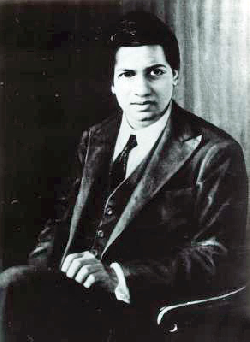
Srinivasa Ramanujan Part 3
Mathematician
- Life
- 22 December 1887 - 26 April 1920
- Birthday
- December 22
- Length
- 10 parts
Mr. Ramanujan's methods were so terse and novel and his presentation so lacking in clearness and precision, that the ordinary [mathematical reader], unaccustomed to such intellectual gymnastics, could hardly follow him. Ramanujan later wrote another paper and also continued to provide problems in the Journal.Neville (March 1942), p292. In early 1912, he got a temporary job in the Madras Accountant General's office, with a salary of 20 rupees per month. He lasted for only a few weeks.Srinivasan (1968), p176. Toward the end of that assignment he applied for a position under the Chief Accountant of the Madras Port Trust. In a letter dated 9 February 1912, Ramanujan wrote:
Sir, I understand there is a clerkship vacant in your office, and I beg to apply for the same. I have passed the Matriculation Examination and studied up to the F.A. but was prevented from pursuing my studies further owing to several untoward circumstances. I have, however, been devoting all my time to Mathematics and developing the subject. I can say I am quite confident I can do justice to my work if I am appointed to the post. I therefore beg to request that you will be good enough to confer the appointment on me.Srinivasan (1968), p31.
Attached to his application was a recommendation from E. W. Middlemast, a mathematics professor at the Presidency College, who wrote that Ramanujan was "a young man of quite exceptional capacity in Mathematics".Srinivasan (1968), p49. Three weeks after he had applied, on 1 March, Ramanujan learned that he had been accepted as a Class III, Grade IV accounting clerk, making 30 rupees per month. At his office, Ramanujan easily and quickly completed the work he was given, so he spent his spare time doing mathematical research. Ramanujan's boss, Sir Francis Spring, and S. Narayana Iyer, a colleague who was also treasurer of the Indian Mathematical Society, encouraged Ramanujan in his mathematical pursuits.
Contacting English mathematicians
In the spring of 1913, Narayana Iyer, Ramachandra Rao and E. W. Middlemast tried to present Ramanujan's work to British mathematicians. One mathematician, M. J. M. Hill of University College London, commented that Ramanujan's papers were riddled with holes. He said that although Ramanujan had "a taste for mathematics, and some ability", he lacked the educational background and foundation needed to be accepted by mathematicians.Letter from M. J. M. Hill to a C. L. T. Griffith (a former student who sent the request to Hill on Ramanujan's behalf), 28 November 1912. Although Hill did not offer to take Ramanujan on as a student, he did give thorough and serious professional advice on his work. With the help of friends, Ramanujan drafted letters to leading mathematicians at Cambridge University.
The first two professors, H. F. Baker and E. W. Hobson, returned Ramanujan's papers without comment. On 16 January 1913, Ramanujan wrote to G. H. Hardy. Coming from an unknown mathematician, the nine pages of mathematics made Hardy initially view Ramanujan's manuscripts as a possible "fraud". Hardy recognised some of Ramanujan's formulae but others "seemed scarcely possible to believe". One of the theorems Hardy found so incredible was found on the bottom of page three (valid for 0 \int_0^\infty \cfrac{1+{x}^2/({b+1})^2}{1+{x}^2/({a})^2} \times\cfrac{1+{x}^2/({b+2})^2}{1+{x}^2/({a+1})^2}\times\cdots\;\;dx = \frac{\sqrt \pi}{2} \times\frac{\Gamma(a+\frac{1}{2})\Gamma(b+1)\Gamma(b-a+\frac{1}{2})}{\Gamma(a)\Gamma(b+\frac{1}{2})\Gamma(b-a+1)}.
Hardy was also impressed by some of Ramanujan's other work relating to infinite series:
1 - 5\left(\frac{1}{2}\right)^3 + 9\left(\frac{1\times3}{2\times4}\right)^3 - 13\left(\frac{1\times3\times5}{2\times4\times6}\right)^3 + \cdots = \frac{2}{\pi} 1 + 9\left(\frac{1}{4}\right)^4 + 17\left(\frac{1\times5}{4\times8}\right)^4 + 25\left(\frac{1\times5\times9}{4\times8\times12}\right)^4 + \cdots = \frac{2^\frac{3}{2}}{\pi^\frac{1}{2}\Gamma^2\left(\frac{3}{4}\right)}.Continue reading: part 4 of 10 →

