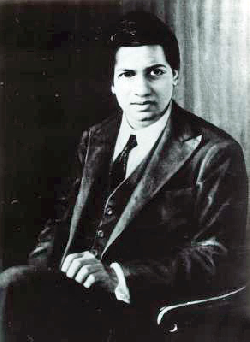
Srinivasa Ramanujan
Mathematician
- Life
- 22 December 1887 - 26 April 1920
- Birthday
- December 22
- Length
- 10 parts
Srinivasa Ramanujan FRS () ( 22 December 188726 April 1920) was an Indian mathematician and autodidact who, with almost no formal training in pure mathematics, made extraordinary contributions to mathematical analysis, number theory, infinite series, and continued fractions. Living in India with no access to the larger mathematical community, which was centred in Europe at the time, Ramanujan developed his own mathematical research in isolation. As a result, he sometimes rediscovered known theorems in addition to producing new work. Ramanujan was said to be a natural genius by the English mathematician G. H. Hardy, in the same league as mathematicians such as Euler and Gauss.C.P. Snow Foreword to "A Mathematician's Apology" by G.H. Hardy He died at the age of 32.
Born at Erode, Madras Presidency (now Tamil Nadu) in a Tamil Brahmin family of Thenkalai Iyengar secthttp://www.3quarksdaily.com/3quarksdaily/2011/01/the-use-and-misuse-of-srinivasa-ramanujan.htmlhttp://mathsc.tripod.com/ramanujan/sramanujan.htm Ramanujan's introduction to formal mathematics began at age 10. He demonstrated a natural ability, and was given books on advanced trigonometry written by S. L. Loney that he mastered by the age of 12; he even discovered theorems of his own, and re-discovered Euler's identity independently. He demonstrated unusual mathematical skills at school, winning accolades and awards. By 17, Ramanujan had conducted his own mathematical research on Bernoulli numbers and the Euler–Mascheroni constant.
Ramanujan received a scholarship to study at Government College in Kumbakonam, which was later rescinded when he failed his non-mathematical coursework. He joined another college to pursue independent mathematical research, working as a clerk in the Accountant-General's office at the Madras Port Trust Office to support himself. In 1912–1913, he sent samples of his theorems to three academics at the University of Cambridge. G. H. Hardy, recognizing the brilliance of his work, invited Ramanujan to visit and work with him at Cambridge. He became a Fellow of the Royal Society and a Fellow of Trinity College, Cambridge. Ramanujan died of illness, malnutrition, and possibly liver infection in 1920 at the age of 32.
During his short lifetime, Ramanujan independently compiled nearly 3900 results (mostly identities and equations). Nearly all his claims have now been proven correct, although a small number of these results were actually false and some were already known. He stated results that were both original and highly unconventional, such as the Ramanujan prime and the Ramanujan theta function, and these have inspired a vast amount of further research. However, the mathematical mainstream has been rather slow in absorbing some of his major discoveries. The Ramanujan Journal, an international publication, was launched to publish work in all areas of mathematics influenced by his work.
In December 2011, in recognition of his contribution to mathematics, the Government of India declared that Ramanujan's birthday (22 December) should be celebrated every year as National Mathematics Day, and also declared 2012 the National Mathematics Year., Vigyan Prasar Science Portal, vigyanprasar.gov.in
Adulthood in India
On 14 July 1909, Ramanujan was married to a ten-year old bride, Janakiammal (21 March 1899 – 13 April 1994). She came from Rajendram, a village close to Marudur (Karur district) Railway Station. Ramanujan's father did not participate in the marriage ceremony.
After the marriage, Ramanujan developed a hydrocele testis, an abnormal swelling of the tunica vaginalis, an internal membrane in the testicle. The condition could be treated with a routine surgical operation that would release the blocked fluid in the scrotal sac. His family did not have the money for the operation, but in January 1910, a doctor volunteered to do the surgery for free.
After his successful surgery, Ramanujan searched for a job. He stayed at friends' houses while he went door to door around the city of Madras (now Chennai) looking for a clerical position. To make some money, he tutored some students at Presidency College who were preparing for their F.A. exam.
Continue reading: part 2 of 10 →

