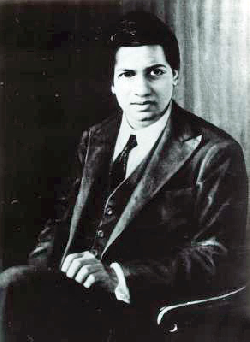
Srinivasa Ramanujan Part 2
Mathematician
- Life
- 22 December 1887 - 26 April 1920
- Birthday
- December 22
- Length
- 10 parts
In late 1910, Ramanujan was sick again, possibly as a result of the surgery earlier in the year. He feared for his health, and even told his friend, R. Radakrishna Iyer, to "hand these [Ramanujan's mathematical notebooks] over to Professor Singaravelu Mudaliar [the mathematics professor at Pachaiyappa's College] or to the British professor Edward B. Ross, of the Madras Christian College." After Ramanujan recovered and got back his notebooks from Iyer, he took a northbound train from Kumbakonam to Villupuram, a coastal city under French control., p. 23.Srinivasan (1968), Vol. 1, p99.
Attention towards mathematics
Ramanujan met deputy collector V. Ramaswamy Aiyer, who had recently founded the Indian Mathematical Society. Ramanujan, wishing for a job at the revenue department where Ramaswamy Aiyer worked, showed him his mathematics notebooks. As Ramaswamy Aiyer later recalled:
I was struck by the extraordinary mathematical results contained in it [the notebooks]. I had no mind to smother his genius by an appointment in the lowest rungs of the revenue department.Srinivasan (1968), Vol. 1, p129.
Ramaswamy Aiyer sent Ramanujan, with letters of introduction, to his mathematician friends in Madras. Some of these friends looked at his work and gave him letters of introduction to R. Ramachandra Rao, the district collector for Nellore and the secretary of the Indian Mathematical Society.Srinivasan (1968), Vol. 1, p86. Ramachandra Rao was impressed by Ramanujan's research but doubted that it was actually his own work. Ramanujan mentioned a correspondence he had with Professor Saldhana, a notable Bombay mathematician, in which Saldhana expressed a lack of understanding for his work but concluded that he was not a phony. Ramanujan's friend, C. V. Rajagopalachari, persisted with Ramachandra Rao and tried to quell any doubts over Ramanujan's academic integrity. Rao agreed to give him another chance, and he listened as Ramanujan discussed elliptic integrals, hypergeometric series, and his theory of divergent series, which Rao said ultimately "converted" him to a belief in Ramanujan's mathematical brilliance. When Rao asked him what he wanted, Ramanujan replied that he needed some work and financial support. Rao consented and sent him to Madras. He continued his mathematical research with Rao's financial aid taking care of his daily needs. Ramanujan, with the help of Ramaswamy Aiyer, had his work published in the Journal of Indian Mathematical Society.
One of the first problems he posed in the journal was:
\sqrt{1+2\sqrt{1+3 \sqrt{1+\cdots}}}.He waited for a solution to be offered in three issues, over six months, but failed to receive any. At the end, Ramanujan supplied the solution to the problem himself. On page 105 of his first notebook, he formulated an equation that could be used to solve the infinitely nested radicals problem.
x+n+a = \sqrt{ax+(n+a)^2 +x\sqrt{a(x+n)+(n+a)^2+(x+n) \sqrt{\cdots}}}Using this equation, the answer to the question posed in the Journal was simply 3. Ramanujan wrote his first formal paper for the Journal on the properties of Bernoulli numbers. One property he discovered was that the denominators of the fractions of Bernoulli numbers were always divisible by six. He also devised a method of calculating Bn based on previous Bernoulli numbers. One of these methods went as follows:
It will be observed that if n is even but not equal to zero, (i) Bn is a fraction and the numerator of {B_n \over n} in its lowest terms is a prime number, (ii) the denominator of Bn contains each of the factors 2 and 3 once and only once, (iii) 2^n(2^n-1){b_n \over n} is an integer and 2(2^n-1)B_n\, consequently is an odd integer.
In his 17-page paper, "Some Properties of Bernoulli's Numbers", Ramanujan gave three proofs, two corollaries and three conjectures. Ramanujan's writing initially had many flaws. As Journal editor M. T. Narayana Iyengar noted:
Continue reading: part 3 of 10 →

