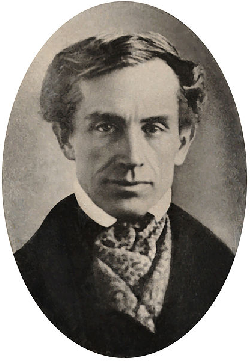
Samuel Morse Part 5
United States painter and inventor
- Life
- April 27, 1791 - April 2, 1872
- Birthday
- April 27
- Length
- 7 parts
There is an argument amongst historians that Morse may have received the idea of a plausible telegraph from Harrison Gray Dyar some eighteen years earlier than his patent.Swayne, p. 241: "Harrison Gray Dyar of Concord erected the first real line and despatched the first message over it by electricity ever sent by such means in America. This may seem strange to most of our readers," says Alfred Munroe in Concord and the Telegraph, "as the credit of this great discovery has been generally conceded to Prof. Morse, but the latter deserves credit only for combining and applying the discovery of others."
References and notes
Honors and awards
Despite honors and financial awards received from foreign countries there was no such recognition in the U.S. until he neared the end of his life, when on June 10, 1871 a bronze statue of Samuel Morse was unveiled in Central Park, New York City. An engraved portrait of Morse appeared on the reverse side of the United States two-dollar bill silver certificate series of 1896. He was depicted along with Robert Fulton. An example can be seen on the website of the Federal Reserve Bank of San Francisco's website in their "American Currency Exhibit":
A blue plaque was erected to commemorate him at 141 Cleveland Street, London, where he lived from 1812 to 1815.
According to his The New York Times obituary published on April 3, 1872, Morse received respectively the decoration of the Atiq Nishan-i-Iftikhar (English: Order of Glory) [first medal on wearer's right depicted in photo of Morse with medals], set in diamonds, from Sultan Abdülmecid of Turkey (c.1847According to , the Ottoman ruler was the first head of state to award a medal to Morse and it was issued after the demonstration in Istanbul.), a golden snuff box containing the Prussian gold medal for scientific merit from the King of Prussia (1851); the Great Gold Medal of Arts and Sciences from the King of Württemberg (1852); and the Great Golden Medal of Science and Arts from Emperor of Austria (1855); a cross of Chevalier in the Légion d'honneur from the Emperor of France; the Cross of a Knight of the Order of the Dannebrog from the King of Denmark (1856); the Cross of Knight Commander of the Order of Isabella the Catholic, from the Queen of Spain, besides being elected member of innumerable scientific and art societies in this [United States] and other countries. Other awards include Order of the Tower and Sword from the kingdom of Portugal (1860); and Italy conferred on him the insignia of chevalier of the Order of Saints Maurice and Lazarus in 1864. Morse's telegraph was recognized as an IEEE Milestone in 1988.
On April 1, 2012, Google announced the release of "Gmail Tap", an April Fools' Day joke that allowed users to use Morse Code to send text from their mobile phones. Morse's great-great-grandnephew Reed Morse—a Google engineer—was instrumental in the prank, which became a real product.http://mail.google.com/mail/help/promos/tap/index.html
Painting
Morse expressed some of his Calvinist beliefs in his painting Landing of the Pilgrims, through the depiction of simple clothing as well as the people's austere facial features. His image captured the psychology of the Federalists; Calvinists from England brought to North America ideas of religion and government, thus linking the two countries. This work attracted the attention of the notable artist Washington Allston. Allston wanted Morse to accompany him to England to meet the artist Benjamin West. Allston arranged — with Morse's father — a three-year stay for painting study in England, and young Morse set sail with the older artist aboard the Lybia on July 15, 1811.
In England, Morse perfected his painting techniques under Allston's watchful eye; by the end of 1811, he gained admittance to the Royal Academy. At the Academy, he was moved by the art of the Renaissance and paid close attention to the works of Michelangelo and Raphael. After observing and practicing life drawing and absorbing its anatomical demands, the young artist produced his masterpiece, the Dying Hercules. (He first made a sculpture as a study for the painting.)
Continue reading: part 6 of 7 →

