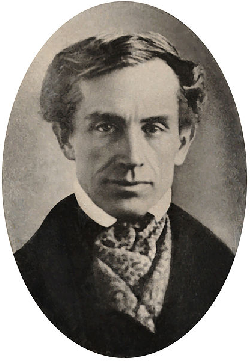
Samuel Morse Part 2
United States painter and inventor
- Life
- April 27, 1791 - April 2, 1872
- Birthday
- April 27
- Length
- 7 parts
Morse encountered the problem of getting a telegraphic signal to carry over more than a few hundred yards of wire. His breakthrough came from the insights of Professor Leonard Gale, who taught chemistry at New York University (a personal friend of Joseph Henry). With Gale's help, Morse introduced extra circuits or relays at frequent intervals and was soon able to send a message through ten miles (16 km) of wire. This was the great breakthrough he had been seeking. Morse and Gale were soon joined by an enthusiastic young man, Alfred Vail, who had excellent skills, insights and money. At the Speedwell Ironworks in Morristown, New Jersey on January 11, 1838, Morse and Vail made the first public demonstration of the electric telegraph. Although Morse and Alfred Vail had done most of the research and development in the ironworks facilities, they chose a nearby factory house as the demonstration site. Without the repeater,
Morse then devised a system of electromagnetic relays, and this was the key element, in that it put no limit to the distance a message could be sent. the range of the telegraph was limited to two miles (3 km), and the inventors had pulled two miles (3 km) of wires inside the factory house through an elaborate scheme. The first public transmission, with the message "A patient waiter is no loser", was witnessed by a mostly local crowd.In 1838 a trip to Washington, D.C., failed to attract federal sponsorship for a telegraph line. Morse then traveled to Europe seeking both sponsorship and patents, but in London discovered that Cooke and Wheatstone had already established priority. Morse would need the financial backing of Maine congressman Francis Ormand Jonathan Smith.
Slavery, anti-Catholic and anti-immigration efforts
Morse was a leader in the anti-Catholic and anti-immigration movement of the mid-19th century. In 1836, he ran unsuccessfully for mayor of New York under the anti-immigrant Nativist Party's banner, receiving only 1496 votes. When Morse visited Rome, he refused to take his hat off in the presence of the Pope. Upon seeing this, an offended Swiss Guardsman rushed over and knocked the hat off of his head. Morse worked to unite Protestants against Catholic institutions (including schools), wanted to forbid Catholics from holding public office, and promoted changing immigration laws to limit immigration from Catholic countries. On this topic, he wrote, “We must first stop the leak in the ship through which muddy waters from without threaten to sink us.”Billington, Ray A. 'Anti-Catholic Propaganda and the Home Missionary Movement, 1800–1860' The Mississippi Valley Historical Review, Vol. 22, No. 3, (December, 1935), pp. 361–384. Published by Organization of American Historians.
Morse was the author of a number of letters to the New York Observer (his brother Sidney was the editor at the time) urging people to fight the perceived Catholic menace. These articles were widely reprinted in other newspapers. Among other claims, he believed that the Austrian government and Catholic aid organizations were subsidizing Catholic immigration to the United States in order to gain control of the country.Curran, Thomas J. International Migration Digest, Vol. 3, No. 1, (Spring, 1966), pp. 15–25 Published by The Center for Migration Studies of New York, Inc.
In his Foreign Conspiracy Against the Liberties of the United States, Morse wrote: “Surely American Protestants, freemen, have discernment enough to discover beneath them the cloven foot of this subtle foreign heresy. They will see that Popery is now, what it has ever been, a system of the darkest political intrigue and despotism, cloaking itself to avoid attack under the sacred name of religion. They will be deeply impressed with the truth, that Popery is a political as well as a religious system; that in this respect it differs totally from all other sects, from all other forms of religion in the country.”
In the 1850s, Morse became well known as a defender of America's institution of slavery, considering it to be sanctioned by God. In his treatise "An Argument on the Ethical Position of Slavery," he wrote:
Continue reading: part 3 of 7 →

