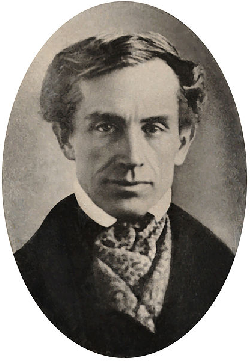
Samuel Morse
United States painter and inventor
- Life
- April 27, 1791 - April 2, 1872
- Birthday
- April 27
- Length
- 7 parts
Birthplace of Morse, Charlestown, MA. ca.1898 photo.
Samuel Finley Breese Morse (April 27, 1791 – April 2, 1872) was an American painter who turned inventor. Already well known as a portrait painter, in his middle age he contributed to the invention of a single-wire telegraph system based on European telegraphs, was a co-inventor of the Morse code, and helped to develop the commercial use of telegraphy.
Morse additionally supported the institution of slavery as well as anti-Catholic and anti-immigration efforts within the United States.
Marriages
Morse married Lucretia Pickering Walker on September 29, 1818, in Concord, New Hampshire. She died on February 7, 1825, shortly after the birth of their third child (Susan b. 1819, Charles b. 1823, James b. 1825). He married his second wife, Sarah Elizabeth Griswold on August 10, 1848 in Utica, New York and had four children (Samuel b. 1849, Cornelia b. 1851, William b. 1853, Edward b. 1857).
Attributed artworks
| Year | Title | Image | Collection | Comments |
|---|---|---|---|---|
| 1820 | Latham Avery (c. 1820), oil on canvas (attributed to Samuel F. B. Morse) | Subject: lived 1775–1845; husband of Betsey Wood Lester (m. 1816). | ||
| 1820 | Mrs. Latham Avery (c. 1820), oil on canvas (attributed to Samuel F. B. Morse) | Subject: Betsey Wood Lester (1787-1837). | ||
Later years
New York's Central Park, dedicated 1871]]
In the United States, Morse held his telegraph patent for many years, but it was both ignored and contested. In 1853 the case of the patent came before the U.S. Supreme Court where, after very lengthy investigation, Chief Justice Roger B. Taney ruled that Morse had been the first to combine the battery, electromagnetism, the electromagnet and the correct battery configuration into a workable practical telegraph. However, in spite of this clear ruling, Morse still received no official recognition from the United States government.
The Supreme Court did not accept all of Morse's claims. The O'Reilly v. Morse case has become known among patent lawyers because the Supreme Court explicitly denied Morse's claim for any future application of his code system. The decision has been cited as relevant to the patent eligibility of software.
Assisted by the American ambassador in Paris, the governments of Europe were approached about their long neglect of Morse while their countries were using his invention. There was a widespread recognition that something must be done, and "in 1858 Morse was awarded the sum of 400,000 French francs (equivalent to about $80,000 at the time) by the governments of France, Austria, Belgium, the Netherlands, Piedmont, Russia, Sweden, Tuscany and Turkey, each of which contributed a share according to the number of Morse instruments in use in each country." In 1858, he was also elected a foreign member of the Royal Swedish Academy of Sciences.
In addition to the telegraph, Morse invented a marble-cutting machine that could carve three dimensional sculptures in marble or stone. He could not patent it, however, because of an existing 1820 Thomas Blanchard design.
Samuel Morse was a generous man who gave large sums to charity. He also became interested in the relationship of science and religion and provided the funds to establish a lectureship on 'the relation of the Bible to the Sciences'. Morse was not a selfish man. Other people and corporations made millions using his inventions, yet most rarely paid him for the use of his patented telegraph. He was not bitter about this, though he would have appreciated more rewards for his labors. Morse was comfortable; by the time of his death, his estate was valued at some $500,000 ($ today).


