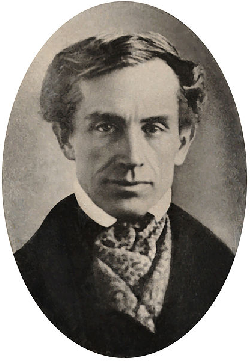
Samuel Morse Part 4
United States painter and inventor
- Life
- April 27, 1791 - April 2, 1872
- Birthday
- April 27
- Length
- 7 parts
The first telegraph office
On May 24, 1844, the line was officially opened as Morse sent the famous words "What hath God wrought" from the Supreme Court chamber in the basement of the U.S. Capitol building in Washington, D.C., to the B&O's Mount Clare Station in Baltimore. Annie Ellsworth chose these words from the Bible (Numbers 23:23); her father, U.S. Patent Commissioner Henry Leavitt Ellsworth, had championed Morse's invention and secured early funding for it. His telegraph could transmit thirty characters per minute.Gleick, J (2011), The Information: a History, a Theory, a Flood, London, Fourth Estate, p144
In May 1845 the Magnetic Telegraph Company was formed in order to radiate telegraph lines from New York City towards Philadelphia, Boston, Buffalo, New York and the Mississippi.
Morse also at one time adopted Wheatstone and Carl August von Steinheil's idea of broadcasting an electrical telegraph signal through a body of water or down steel railroad tracks or anything conductive. He went to great lengths to win a lawsuit for the right to be called "inventor of the telegraph", and promoted himself as being an inventor, but Alfred Vail played an important role in the invention of the Morse Code, which was based on earlier codes for the electromagnetic telegraph.
Birth and education
Samuel F. B. Morse was born in Charlestown, Massachusetts, the first child of the pastor Jedidiah Morse (1761–1826)—who was also a geographer—and Elizabeth Ann Finley Breese (1766–1828). His father was a great preacher of the Calvinist faith and supporter of the American Federalist party. He thought it helped preserve Puritan traditions (strict observance of Sabbath, among other things), and believed in the Federalist support of an alliance with Britain and a strong central government. Morse strongly believed in education within a Federalist framework, alongside the instillation of Calvinist virtues, morals and prayers for his first son.
After attending Phillips Academy in Andover, Massachusetts, Samuel Morse went on to Yale College to receive instruction in the subjects of religious philosophy, mathematics and science of horses. While at Yale, he attended lectures on electricity from Benjamin Silliman and Jeremiah Day. He supported himself by painting. In 1810, he graduated from Yale with Phi Beta Kappa honors.In 1961, Yale named Morse College, one of its twelve residential colleges, after him.
Patents
Patent
Samuel Morse received a patent for the telegraph in 1847, at the old Beylerbeyi Palace (the present Beylerbeyi Palace was built in 1861–1865 on the same location) in Istanbul, which was issued by Sultan Abdülmecid who personally tested the new invention. He was elected an Associate Fellow of the American Academy of Arts and Sciences in 1849. The original patent went to the Breese side of the family after the death of Samuel Morse.
In the 1850s, Morse went to Copenhagen and visited the , where the sculptor's grave is in the inner courtyard. He was received by King Frederick VII, who decorated him with the Order of the Dannebrog. Morse expressed his wish to donate his portrait from 1830 to the king. The Thorvaldsen portrait today belongs to Margrethe II of Denmark.
The Morse telegraphic apparatus was officially adopted as the standard for European telegraphy in 1851. Only the United Kingdom (with its extensive overseas empire) kept the needle telegraph of Cooke and Wheatstone.
In 1858, Morse introduced wired communication to Latin America when he established a telegraph system in Puerto Rico, then a Spanish Colony. Morse's oldest daughter, Susan Walker Morse (1821–1885), would often visit her uncle Charles Pickering Walker who owned the Hacienda Concordia in the town of Guayama. During one of her visits she met and later married Edward Lind, a Danish merchant who worked in the Hacienda La Henriqueta in the town of Arroyo. Lind purchased the Hacienda from his sister when she became a widow. Morse, who often spent his winters at the Hacienda with his daughter and son-in-law, set a two-mile telegraph line connecting his son-in-law's Hacienda to their house in Arroyo. The line was inaugurated on March 1, 1859, in a ceremony flanked by the Spanish and American flags. The first lines transmitted by Samuel Morse that day in Puerto Rico were: "Puerto Rico, beautiful jewel! When you are linked with the other jewels of the Antilles in the necklace of the world's telegraph, yours will not shine less brilliantly in the crown of your Queen!"
Continue reading: part 5 of 7 →

