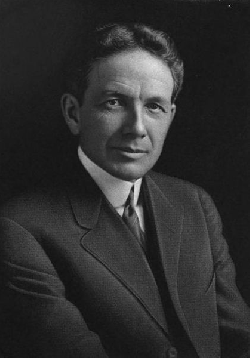
Preston Tucker Part 6
American businessman
- Life
- September 21, 1903 – December 26, 1956
- Birthday
- September 21
- Field
- Founders
- Length
- 6 parts
The location of the former Tucker Corporation at 7401 S Cicero Ave, Chicago, IL 60629-5818, is now the corporate headquarters of Tootsie Roll Industries and the Ford City Mall (the building was owned for a time by Ford Motor Company). The building is so large that it was split in two, and even with a large open area between the two resulting buildings, each structure is still substantial.
Tucker’s 1948 Sedan’s revolutionary ideas in car safety helped formulate car safety standards. The Tucker family held on to Aircooled Motors until 1961, when it was sold to Aero Industries.
Today, remaining original stock certificates for Tucker Corporation common stock, circa 1947, are valuable to collectors, and are worth more than when originally issued.Catalogued with an estimated value of between $2000-3000 by W. M. Smythe & Co. in New York City in 2003. Over 10,000 Stock certificates were personally signed by Preston Tucker, making these the most desirable.
Early life (1903-1933)
Preston Tucker was born on September 21, 1903, on a peppermint farm near Capac, Michigan. He grew up outside Detroit in the suburb of Lincoln Park, Michigan. Tucker was raised by his mother, a teacher, after his father died of appendicitis when Preston was 2 years old. First learning to drive at age 11, Tucker was obsessed with automobiles from an early age. At age 16, Preston Tucker began purchasing late model automobiles, repairing/refurbishing them and selling the cars for a profit. He attended the Cass Technical High School in Detroit, but he quit school and landed a job as an office boy for the Cadillac Motor Company, where he used rollerskates to make his rounds more efficiently. In 1922, young Tucker joined the Lincoln Park, Michigan police department (against the pleas of his mother), his interest stirred by his desire to drive and ride the fast, high-performance police cars and motorcycles. His mother had him removed from the force, pointing out to department officials that at age nineteen, he was below the department’s minimum required age.
Tucker and his new wife, Vera (married in 1923 at age 20), then took over a 6-month lease on a gas station near Lincoln Park, running the station together. Vera would run the station during the day, while Preston worked on the Ford Motor Company assembly line. After the lease ran out, Tucker quit Ford and returned to the police force again, but in his first winter back he was banned from driving police vehicles by the force after using a blowtorch to cut a hole in the dashboard of a cruiser to allow engine heat to warm the cabin. During the last couple of months at the gas station, Tucker began selling Studebaker cars on the side. He met well known automobile salesman Mitchell W. Dulian, who hired Tucker as a car salesman at his Detroit dealership. Tucker did very well with Dulian, but his dealership was a long drive from Tucker’s Lincoln Park home, so Tucker quit and returned to the police force for the last time. A few months later, Dulian, still impressed with Tucker’s immediate success as a salesman, invited Tucker to move south with him to Memphis, Tennessee to work as sales manager. (Dulian would later become sales manager for the Tucker Car Corp.) Dulian was transferred a couple of years later; Tucker stayed in Memphis and was a salesman for Ivor Schmidt (Stutz) and John Fischer (Chrysler), where he became general sales manager. While managing Chrysler sales in Memphis, Tucker made a connection with Pierce-Arrow. In 1933, Tucker moved to Buffalo, New York and became regional sales manager for Pierce-Arrow automobiles, but after only two years he moved back to Detroit and worked as a Dodge salesman for Cass Motors.
Tucker Combat Car and the Tucker Gun Turret (1939-1941)
In late 1937, while recovering in an Indianapolis hospital from an appendectomy, Tucker was reading the news about war looming on the horizon in Europe. He got the idea of developing a high-speed armored combat vehicle. In 1939, Tucker moved his family back to Michigan and bought a house and property in Ypsilanti. He remodeled an old barn on his property and began and operated a machine shop called the Ypsilanti Machine and Tool Company, planning to use the facility to develop various automotive products.
Opportunity arose for Tucker from the Dutch government, who wanted a combat vehicle suited to the muddy Dutch terrain. Continuing his working relationship with Harry Miller, Tucker and Miller began designing a narrow-wheelbase armored combat car, powered by a Miller-modified Packard V-12 engine. The car was nicknamed the "Tucker Tiger".
At least one prototype of the combat car was built. Production of the car was to be done at the Rahway, New Jersey factory owned by the American Armament Corporation.Tucker Combat Car Promotional Video: http://www.youtube.com/watch?v=mTga-68fplQ The Germans invaded Holland in the spring of 1940, before Tucker could complete the deal, and the Dutch government lost interest, so he completed the prototypes and opted to try to sell the vehicle to the U.S. government. The car could reach over 115 mph (185 km/h), far in excess of the design specifications. The U.S. military felt the vehicle was too fast and had already committed to other combat vehicles. The highly-mobile power-operated gun turret featured on the Tucker combat car, which became known as the "Tucker Turret", earned the interest of the U.S. Navy. Harry Miller would later take some of the designs from the Tucker Combat Car to American Bantam where he was involved in the development of the first Jeep.
The Tucker Turret was soon in production (initially at Tucker’s Ypsilanti machine shop). It was used in PT boats, landing craft, and B-17 and B-29 bombers. Tucker’s patents for the turret were licensed out to various manufacturers to mass produce the turret in the high volume to meet demand. Tucker’s patent rights were stolen and Tucker was embroiled in lawsuits for years trying to recoup royalties for use of his patents on the turret.Pearson, Charles T. (1974). The Indomitable Tin Goose: The True Story of Preston Tucker and His Car. Motorbooks International Publishers & Wholesalers, Minneapolis. ISBN 0-87938-020-9 (hardcover).