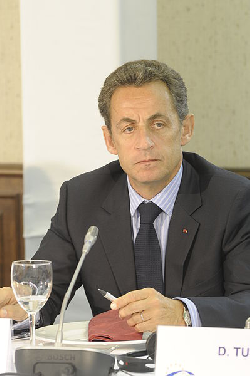
Nicolas Sarkozy Part 7
23rd President of France from 16 May 2007 to 15 May 2012
- Life
- 28 January 1955
- Birthday
- January 28
- Field
- State, Presidents
- Length
- 11 parts
On 29 June 2011, he did an 11th government reshuffle, after the resignation of Christine Lagarde, who was appointed to head the International Monetary Fund. Five new ministers were appointed.
Middle East
Involvement in Libya
Muammar Gaddafi’s official visit to Nicolas Sarkozy in December 2007 has triggered a strong wave of protests against the President in France. In March 2011, after having been criticized for his unwillingness to support the Egyptian and Tunisian revolutions, and persuaded by the philosopher Bernard-Henri Levy to have France actively engage against the forces of the Libyan leader, Muammar Gaddafi, Nicolas Sarkozy was amongst the first Heads of State to demand the resignation of Gaddafi and his government, which was then fighting a civil war in Libya. On 10 March 2011, Nicolas Sarkozy welcomed to the Elysee Palace, three emissaries from the Libyan National Transitional Council (NTC), brought to him by Bernard-Henri Levy who mediated at the meeting. Nicolas Sarkozy promised them a no-fly zone would be imposed on Gaddafi’s aeroplanes. He also promised them France’s military assistance. On 17 March 2011, at the behest of France, resolution 1973 was adopted by the Security Council of the United Nations, permitting the creation of a "no fly" zone over Libya, and for the undertaking of "necessary measures" for the protection of the country’s civilian population. On 19 March 2011, Nicolas Sarkozy officially announced the beginning of a military intervention in Libya, with France’s participation. These actions of Nicolas Sarkozy were favorably received by the majority of the French political class and public opinion. "No Exit" by Philip Gourevitch, 12 December 2011, New Yorker
Notes
Post-Presidency
After his defeat at the 2012 election, Nicolas Sarkozy asked his followers to respect Hollande’s victory. He invited his successor with François Hollande to attend his last 8 May Victory in Europe Day commemoration. His last day as President of the French Republic was 15 May.
He then went on holiday, invited by several heads of state, clearly signifying that he would not return to national politics in a short term. However, on 8 August, faced with the rising civil war in Syria, he asked the government (particularly François Hollande and Laurent Fabius, his Foreign Minister) to act quickly, speaking publicly for the first time since his defeat.
Personal life
Family background
Sarkozy is the son of Pál István Ernő Sárközy de Nagy-Bócsa. "Sarkozy" is the westernized, or internationalized, version of his Hungarian name. In Hungarian the given name comes last rather than first. The French aristocratic particle "de" is also used instead of the Hungarian aristocratic ending "-i". This westernization of Hungarian names is frequent, particularly for people with an aristocratic name. For example the leader of Hungary from 1920 to 1944, whose Hungarian name is nagybányai Horthy Miklós, is known in English as Miklós Horthy de Nagybánya. The French name of Pál Sárközy de Nagy-Bócsa changed in 1948 to Paul Étienne Arnaud Sarközy de Nagy-Bocsa, when Pál was translated as Paul in French, and the acute accents on the "a" of Sarközy and the "o" of Bocsa were dropped as these letters never carry an acute accent (accent aigu) in French. The trema on the "o" of Sárközy was kept, probably because French typewriters allow this combination, whereas it is impossible to write "a" or "o" with an acute accent using a French typewriter. ( in some sources Nagy-Bócsay Sárközy Pál István Ernő), a Hungarian aristocrat, and Andrée Jeanne "Dadu" Mallah (b. Paris, 12 October 1925), whose Greek Jewish father converted to Catholicism to marry Sarkozy’s French Catholic maternal grandmother. They were married in the Saint-François-de-Sales church, 17th arrondissement of Paris, on 8 February 1950 and divorced in 1959.
Early life
During Sarkozy’s childhood, his father founded his own advertising agency and became wealthy. The family lived in a mansion owned by Sarkozy’s maternal grandfather, Benedict Mallah, in the 17th Arrondissement of Paris. The family later moved to Neuilly-sur-Seine, one of the wealthiest communes of the Île-de-France région immediately west of the 17th Arrondissement just outside of Paris. According to Sarkozy, his staunchly Gaullist grandfather was more of an influence on him than his father, whom he rarely saw. Sarkozy was, accordingly, raised Catholic.
Continue reading: part 8 of 11 →


