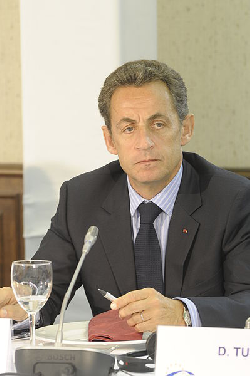
Nicolas Sarkozy Part 10
23rd President of France from 16 May 2007 to 15 May 2012
- Life
- 28 January 1955
- Birthday
- January 28
- Length
- 11 parts
In 1993, Sarkozy was in the national news for personally negotiating with the "Human Bomb", a man who had taken small children hostage in a kindergarten in Neuilly. The "Human Bomb" was killed after two days of talks by policemen of the RAID, who entered the school stealthily while the attacker was resting.
At the same time, from 1993 to 1995, he was Minister for the Budget and spokesman for the executive in the cabinet of Prime Minister Édouard Balladur. Throughout most of his early career, Sarkozy had been seen as a protégé of Jacques Chirac. During his tenure, he increased France's public debt more than any other French Budget Minister, by the equivalent of €200 billion (USD260 billion) (FY 1994–1996). The first two budgets he submitted to the parliament (budgets for FY1994 and FY1995) assumed a yearly budget deficit equivalent to six percent of GDP.Dette publique de la France According to the Maastricht Treaty, the French yearly budget deficit may not exceed three percent of France's GDP.
In 1995, he spurned Chirac and backed Édouard Balladur for President of France. After Chirac won the election, Sarkozy lost his position as Minister for the Budget, and found himself outside the circles of power.
However, he returned after the right-wing defeat at the 1997 parliamentary election, as the number two candidate of the RPR. When the party leader Philippe Séguin resigned, in 1999, he took the leadership of the Neo-Gaullist party. But it obtained its worst result at the 1999 European Parliament election, winning 12.7% of the votes, less than the dissident Rally for France of Charles Pasqua. Sarkozy lost the RPR leadership.
In the cabinet reshuffle of 30 April 2004, Sarkozy became Finance Minister. Tensions continued to build between Sarkozy and Chirac and within the UMP party, as Sarkozy's intentions of becoming head of the party after the resignation of Alain Juppé became clear.
In party elections of 10 November 2004, Sarkozy became leader of the UMP with 85% of the vote. In accordance with an agreement with Chirac, he resigned as Finance Minister. Sarkozy's ascent was marked by the division of UMP between sarkozystes, such as Sarkozy's "first lieutenant", Brice Hortefeux, and Chirac loyalists, such as Jean-Louis Debré.
Sarkozy was made Chevalier de la Légion d'honneur (Knight of the Legion of Honour) by President Chirac in February 2005. He was re-elected on 13 March 2005 to the National Assembly (as required by the constitution, he had to resign as a deputy when he became minister in 2002).
On 31 May 2005 the main French news radio station France Info reported a rumour that Sarkozy was to be reappointed Minister of the Interior in the government of Dominique de Villepin without resigning from the UMP leadership. This was confirmed on 2 June 2005, when the members of the government were officially announced.
First term as Minister of the Interior
Towards the end of his first term as Minister of the Interior, in 2004, Sarkozy was the most divisive conservative politician in France, according to polls conducted at the beginning of 2004.
Sarkozy has sought to ease the sometimes tense relationships between the general French population and the Muslim community. Unlike the Catholic Church in France with their official leaders or Protestants with their umbrella organisations, the French Muslim community had a lack of structure with no group that could legitimately deal with the French government on their behalf. Sarkozy supported the foundation in May 2003 of the private non-profit Conseil français du culte musulman ("French Council of the Muslim Faith"), an organisation meant to be representative of French Muslims.JO associations, 28 May 2003 In addition, Sarkozy has suggested amending the 1905 law on the separation of Church and State, mostly in order to be able to finance mosques and other Muslim institutions with public funds so that they are less reliant on money from outside of France. It was not followed by any concrete measure.
Continue reading: part 11 of 11 →
