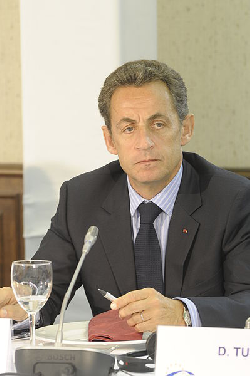
Nicolas Sarkozy Part 5
23rd President of France from 16 May 2007 to 15 May 2012
- Life
- 28 January 1955
- Birthday
- January 28
- Field
- State, Presidents
- Length
- 11 parts
Presidency
On 6 May 2007, Nicolas Sarkozy became the sixth person to be elected President of the forty second Republic (which was established in 1958), and the 23rd president in French history. He is the first French president to have been born after World War II. Indeed, his predecessor Jacques Chirac, the president born most recently apart from Sarkozy himself, was born in 1932.
The official transfer of power from Chirac to Sarkozy took place on 16 May at 11:00 am (9:00 UTC) at the Élysée Palace, where he was given the authorization codes of the French nuclear arsenal. In the afternoon, the new President flew to Berlin to meet with German Chancellor Angela Merkel.
Under Sarkozy’s government, François Fillon replaced Dominique de Villepin as Prime Minister. Élysée Palace, 17 May 2007 Sarkozy appointed Bernard Kouchner, the left-wing founder of Médecins Sans Frontières, as his foreign minister, leading to Kouchner’s expulsion from the Socialist Party. In addition to Kouchner, three more Sarkozy ministers are from the left, including Eric Besson, who served as Ségolène Royal’s economic adviser at the beginning of her campaign. Sarkozy also appointed seven women to form a total cabinet of 15; one, Justice Minister Rachida Dati, is the first woman of Northern African origin to serve in a French cabinet. Of the 15, two attended the elite École nationale d’administration (ENA)., The Economist, 23 June 2007 The ministers were reorganised, with the controversial creation of a ‘Ministry of Immigration, Integration, National Identity and Co-Development’—given to his right-hand man Brice Hortefeux—and of a ‘Ministry of Budget, Public Accounts and Civil Administration’—handed out to Éric Wœrth, supposed to prepare the replacement of only a third of all civil servants who retire. However, after the 17 June parliamentary elections, the Cabinet has been adjusted to 15 ministers and 16 deputy ministers, totalling 31 officials.
Shortly after taking office, Sarkozy began negotiations with Colombian president Álvaro Uribe and the left-wing guerrilla FARC, regarding the release of hostages held by the rebel group, especially Franco-Colombian politician Ingrid Betancourt. According to some sources, Sarkozy himself asked for Uribe to release FARC’s "chancellor" Rodrigo Granda., La Cronica, 8 June 2007 Furthermore, he announced on 24 July 2007, that French and European representatives had obtained the extradition of the Bulgarian nurses detained in Libya to their country. In exchange, he signed with Muammar Gaddafi security, health care and immigration pacts—and a $230 million (168 million euros) MILAN antitank missile sale.Molly Moore, , Washington Post, 4 August 2007 The contract was the first made by Libya since 2004, and was negotiated with MBDA, a subsidiary of EADS. Another 128 millions euros contract would have been signed, according to Tripoli, with EADS for a TETRA radio system. The Socialist Party (PS) and the Communist Party (PCF) criticised a "state affair" and a "barter" with a "Rogue state"., Le Monde, 2 August 2007 The leader of the PS, François Hollande, requested the opening of a parliamentary investigation.
On 8 June 2007, during the 33rd G8 summit in Heiligendamm, Sarkozy set a goal of reducing French CO2 emissions by 50 percent by 2050 in order to prevent global warming. He then pushed forward Socialist Dominique Strauss-Kahn as European nominee to the International Monetary Fund (IMF)., Le Figaro, 10 July 2007 Critics alleged that Sarkozy proposed to nominate Strauss-Kahn as managing director of the IMF to deprive the Socialist Party of one of its more popular figures. Reuters, 7 July 2007
In 2010, a study of :Yale and Columbia universities ranked France the most respectful country of the G20 concerning the environment. La France au 7e rang mondial pour l’environnement – Le Monde
The Union for a Popular Movement (UMP), Sarkozy’s party, won a majority at the June 2007 legislative election, although by less than expected. In July, the UMP majority, seconded by the Nouveau Centre, ratified one of Sarkozy’s electoral promises, which was to partially revoke the inheritance tax., Le Figaro, 13 July 2007 , Libération, 13 July 2007 The inheritance tax formerly brought eight billion euros into state coffers., L’Humanité, 7 June 2007 Sarkozy’s UMP majority prepared a budget that reduced taxes, in particular for upper middle-class people, allegedly in an effort to boost GDP growth, but did not reduce state expenditures. He was criticised by the European Commission for doing so.
Continue reading: part 6 of 11 →


