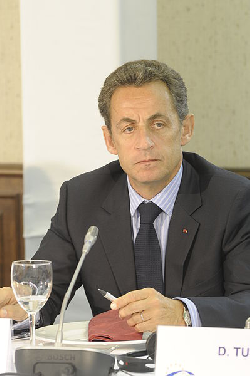
Nicolas Sarkozy Part 11
23rd President of France from 16 May 2007 to 15 May 2012
- Life
- 28 January 1955
- Birthday
- January 28
- Field
- State, Presidents
- Length
- 11 parts
Minister of Finance
During his short appointment as Minister of Finance, Sarkozy was responsible for introducing a number of policies. The degree to which this reflected libéralisme (a hands-off approach to running the economy) or more traditional French state dirigisme (intervention) is controversial. He resigned the day following his election as president of the UMP.
- In September 2004, Sarkozy oversaw the reduction of the government ownership stake in France Télécom from 50.4 percent to 41 percent.
- Sarkozy backed a partial nationalisation of the large engineering company Alstom decided by his predecessor when the company was exposed to bankruptcy in 2003.
- In June 2004, Sarkozy reached an agreement with the major retail chains in France to concertedly lower prices on household goods by an average of two percent; the success of this measure is disputed, with studies suggesting that the decrease was close to one percent in September.
- Taxes: Sarkozy avoided taking a position on the ISF (solidarity tax on wealth). This is considered an ideological symbol by many on the left and right. Some in the business world and on the liberal right, such as Alain Madelin, wanted it abolished. For Sarkozy, that would have risked being categorised by the left as a gift to the richest classes of society at a time of economic difficulties.
Villepin government
Second term as Minister of the Interior
During his second term at the Ministry of the Interior, Sarkozy was initially more discreet about his ministerial activities: instead of focusing on his own topic of law and order, many of his declarations addressed wider issues, since he was expressing his opinions as head of the UMP party.
However, the civil unrest in autumn 2005 put law enforcement in the spotlight again. Sarkozy was accused of having provoked the unrest by calling young delinquents from housing projects "rabble" ("racaille") in Argenteuil near Paris, and controversially suggested cleansing the minority suburbs with a Kärcher. After the accidental death of two youths, which sparked the riots, Sarkozy first blamed it on "hoodlums" and gangsters. These remarks were sharply criticised by many on the left wing and by a member of his own government, Delegate Minister for Equal Opportunities Azouz Begag., Le Monde, 2 November 2005
After the rioting, he made a number of announcements on future policy: selection of immigrants, greater tracking of immigrants, and a reform on the 1945 ordinance government justice measures for young delinquents.
UMP leader
Before he was elected President of France, Sarkozy was president of UMP, the French conservative party, elected with 85 percent of the vote. During his presidency, the number of members has significantly increased. In 2005, he supported a "yes" vote in the French referendum on the European Constitution, but the "No" vote won. Throughout 2005, Sarkozy called for radical changes in France’s economic and social policies. These calls culminated in an interview with Le Monde on 8 September 2005, during which he claimed that the French had been misled for 30 years by false promises. Among other issues:
- he called for a simplified and "fairer" taxation system, with fewer loopholes and a maximum taxation rate (all direct taxes combined) at 50 percent of revenue;
- he approved measures reducing or denying social support to unemployed workers who refuse work offered to them;
- he pressed for a reduction in the budget deficit, claiming that the French state has been living off credit for some time.
Such policies are what are called in France libéral (that is, in favour of laissez-faire economic policies) or, with a pejorative undertone, ultra-libéral. Sarkozy rejects this label of libéral and prefers to call himself a pragmatist.
Sarkozy opened another avenue of controversy by declaring that he wanted a reform of the immigration system, with quotas designed to admit the skilled workers needed by the French economy. He also wants to reform the current French system for foreign students, saying that it enables foreign students to take open-ended curricula in order to obtain residency in France; instead, he wants to select the best students to the best curricula in France.
In early 2006, the French parliament adopted a controversial bill known as DADVSI, which reforms French copyright law. Since his party was divided on the issue, Sarkozy stepped in and organised meetings between various parties involved. Later, groups such as the Odebi League and EUCD.info alleged that Sarkozy personally and unofficially supported certain amendments to the law, which enacted strong penalties against designers of peer-to-peer systems.


