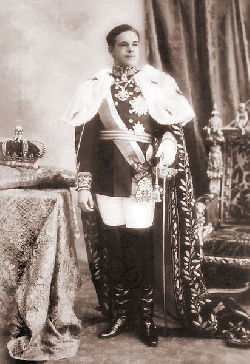
Manuel II of Portugal Part 6
Monarchs
- Life
- 15 November 1889 - 2 July 1932
- Birthday
- November 15
- Length
- 7 parts
In Lisbon, Aires de Ornelas was caught completely by surprise, but he could not escape with other monarchists to the safety of the 2nd Regimental Lancers, in Ajuda. There the number of refugees, who suffered republican reprisals increased, and the commander removed his forces and those civilians, marching them to Monsanto, where the 4th, 7th and 9th Cavalry and the 30th Infantry Battery from Belém were entrenched. Aires de Ornelas wavered in his support, which risked the possibility that Integralists would transfer their loyalty to Miguel's supporters, or assume the leadership of the monarchist movement. In a small area, and circled by Republican forces, the monarchists surrendered on 24 January. With the failure of the Restoration in the centre and south of the country, luck turned on Paiva Couceiro. On 13 February a part of the Republican National Guard deserted and restored the Republic in Oporto. Those monarchists who did not escape were imprisoned and sentenced to long-term imprisonment. The King, in exile, did not hear of the failure and was informed only after reading the reports in the newspapers.
Questão Social
During the 19th century, many intellectuals and politicians were preoccupied with the growth of the urban proletariat as a consequence of the Industrial Revolution. In Portugal, owing to lower levels of industrialisation, this was not an important question, but it was exacerbated by an economic crisis and the interventions of the Republican Party, who believed a republic would resolve the problems. The reaction taken to analyze and find solutions to this phenomenon was the Questão Social (social question) of the times.
The Socialist Party was one of the main proponents, and had existed since 1875, but it never had representation in Parliament. This was not only because it was not popular, but also because the Republican Party was the principal body to channel radical discontent within the political system. The King made some initiatives that did not necessarily infringe his constitutional restrictions, but which created incentives for the Socialist Party to retract or diminish their support for the Republican Party. In 1909, Manuel invited the French sociologist, Léon Poinsard, to travel the country, examine the social environment, and report back to him. In his document, Léon defended that the only way to combat clientelism, created by the system of rotational governments, would be a reorganisation of the work and duties of the local administrations. Enthusiastic, the King wrote, on June 1909, to the President of the Council of Ministers (the Prime Minister) Wenceslau de Sousa Pereira de Lima, to make him aware of the reorganisation of the Socialist Party (under Alfredo Aquiles Monteverde) and to remind him of the importance of collaborating with the Socialists, "...so that, we will empty their supporters from the Republican Party, and orient them into a useful and productive force." Notwithstanding the contacts made by the government of Artur Alberto de Campos Henriques with the Socialist Azedo Gneco, Venceslau de Lima considered this difficult after the Congresso Nacional Operário, which was boycotted by anarchists and republicans. For their part, the Socialists were enthusiastic about Royal support between Manuel and Aquiles Monteverde. Monteverde would later inform the King of the failure of the October 1909 trade union congress, but little was formalised between the socialists and the government, although they supported the work of Poinsard. During the government of António Teixeira de Sousa, in July 1910, that the government created a commission to study the establishment of an Instituto de Trabalho Nacional ("Institute of National Work"), that had three socialists and included Azedo Gneco. However, Aquiles Monteverde would complain that the commission lacked the resources to be effective: specifically that permanent members and unlimited transport, in order for the Socialists to promote their propaganda. Manuel II informed the government, through the Minister of Public Works, that he agreed with the establishment of the Instituto de Trabalho Nacional, but by September, it was too late for the constitutional monarchy.
Continue reading: part 7 of 7 →
